

Legal AI Software Comparison: 9 Top Tools for Indian Firms
If you are running a legal ai software comparison before you sign a contract, you already know the market is crowded. GPT wrappers, US-built platforms with no Indian statute training, and standalone research tools all claim to save time, but most were never built for the Bombay High Court or the Companies Act, 2013. Picking wrong means retraining your team in six months and paying twice.
This article gives you a direct, feature-by-feature look at nine tools Indian firms and legal teams actually use, from general AI models to platforms built specifically for Indian law. You will see how each handles contract review, litigation prep, and legal research, along with rough pricing and where each tool falls short for Indian practice.
We cover enterprise legal teams, solo practitioners, and law students separately, since a corporate legal department managing 200 contracts a month has different needs than an advocate prepping for a single matter. We also include LeXi AI in this comparison, since it was built around Indian commercial law and benchmarked directly against general models like GPT 5.5 and Claude Opus 4.8 on legal reasoning accuracy. By the end, you should know exactly which contract lifecycle management or research tool fits your practice, and which ones to skip.
1. LeXi AI
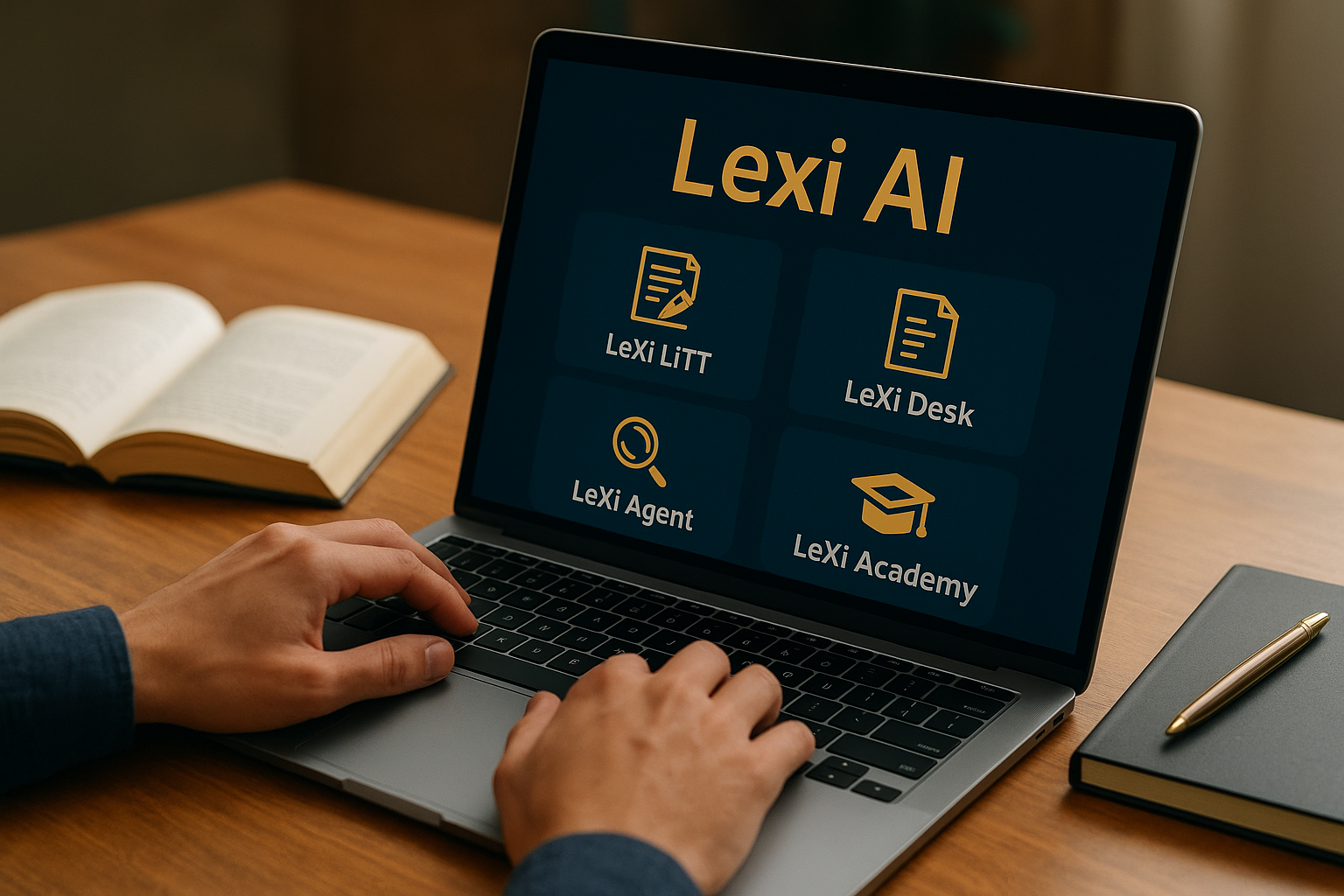
LeXi AI sits at the top of this list because it is the only platform on it built specifically around Indian courts, Indian statutes, and Indian contract law, then benchmarked against general AI models to prove the point. Astute Lex Servicado Private Limited designed it as a full legal intelligence platform rather than a single-purpose tool, so litigation prep, contract management, research, and drafting live inside one connected system instead of four separate logins.
Key features
Four core modules make up the platform, each aimed at a different part of legal work.
- LeXi LiTT handles AI-assisted drafting, case strategy building, and courtroom preparation, including condensing a 400-page case file into a usable summary within minutes.
- LeXi Desk manages the full contract lifecycle, covering drafting, clause risk analysis, clause generation, translation, and document summarization.
- LeXi Agent runs legal research and precedent analysis, with instant judgment search across verified databases.
- LeXi Academy gives law students AI-guided practice in research, drafting, and case analysis before they enter practice.
On the AIBE 20 legal reasoning dataset, LeXi AI scored 98.95 percent on questions tied to Indian commercial law, ahead of GPT 5.5, Gemini 3.1 Pro, Deepseek v3.2, and Claude Opus 4.8 on the same benchmark.
A general AI model trained on global data still has to guess at Indian statutory language, while a model benchmarked on Indian commercial law does not.
Best for
Independent lawyers who need 24/7 legal assistance without hiring an extra associate will find the drafting and research speed useful from the first week. Firms and chambers juggling both litigation and contract work get more out of this than out of single-purpose tools, since clause risk flagging and courtroom prep run on the same platform instead of two different ones. Corporate legal teams managing high contract volumes benefit from the enterprise APIs, which let them build custom workflows around LeXi Desk rather than exporting data between disconnected systems. Students preparing for practice get a dedicated academy track instead of a stripped-down version of the professional product.
Pricing in India
LeXi AI runs on tiered subscription plans rather than one flat rate, since a solo advocate and a 500-lawyer firm need different levels of access.
| Plan type | Who it suits | What is included |
|---|---|---|
| Individual | Independent lawyers, advocates | LiTT, Desk, and Agent access, plus mobile app |
| Firm or Chambers | Law firms, corporate legal teams | Multi-seat access, contract lifecycle tools, priority support |
| Enterprise | Large enterprises, legal departments | Custom APIs, dedicated onboarding, volume-based pricing |
| Academy | Law students | Discounted access to research and drafting practice tools |
Exact rupee figures depend on seat count and which modules a firm selects, so anyone evaluating LeXi AI seriously should request a direct quote instead of assuming a fixed number applies across the board.
2. SpotDraft
SpotDraft built its reputation on contract lifecycle management for startups and mid-size companies, mostly in the US market, with a growing India presence. It handles the paperwork side of legal work well, but it was never built around Indian courts or litigation, so treat it as a contracts tool and nothing more.
Key features
The platform centers on drafting, redlining, and approval workflows for contracts, plus a searchable repository once documents are signed. SpotDraft also offers AI-assisted clause review that flags nonstandard terms and an e-signature integration that closes the loop from draft to execution. There is no litigation module, no case law search, and no Indian statute training built into the core product.
A tool built for contract paperwork will not help you prepare for a hearing, no matter how good its redlining looks.
Best for
SpotDraft suits corporate legal teams at startups and mid-size companies whose work is almost entirely contract-heavy, think NDAs, vendor agreements, and employment contracts moving through repeated approval cycles. It fits teams that already use Slack or Salesforce and want contract workflows tied into those systems. Independent litigators and firms handling court matters will find little use for it, since the platform does not touch case strategy or judgment research at all.
Pricing in India
SpotDraft does not publish flat pricing and quotes are based on seat count and contract volume, generally aimed at businesses rather than solo practitioners.
| Plan type | Who it suits | Notes |
|---|---|---|
| Startup | Small legal or ops teams | Lower seat counts, core CLM features |
| Business | Mid-size corporate legal teams | Custom integrations, higher volume |
| Enterprise | Large companies | Dedicated support, negotiated pricing |
Most Indian buyers report quotes running into lakhs annually depending on team size, so budget accordingly before requesting a demo.
3. CoCounsel by Thomson Reuters
CoCounsel comes from Thomson Reuters, the company behind Westlaw, and it carries that legal research pedigree into a generative AI assistant built for document review and drafting. Thomson Reuters trained the model on legal-specific tasks rather than general internet text, which shows in how it handles contract review and deposition prep. It has limited depth on Indian statutes, though, since its core training and database strength sit in US and UK case law.
Key features
CoCounsel runs on a skill-based structure, where a lawyer picks a task like "review a contract" or "prepare for a deposition" and the tool works through it with citations attached. Its document review skill flags risky clauses and inconsistencies across long contracts, while its research skill pulls from Westlaw's database for citation-backed answers. It also drafts correspondence and summarizes long files, similar in concept to LeXi LiTT's case file summarization, though built around Western legal sources.
A research assistant is only as strong as the database behind it, and CoCounsel's strength sits in Western case law, not Indian judgments.
Best for
Firms with cross-border matters involving US or UK counterparties get the most value here, since CoCounsel's citation accuracy is strongest on those jurisdictions. Litigators focused purely on Indian courts will find the case law coverage thin compared to tools trained specifically on Indian judgments. Large firms already paying for Westlaw access may find CoCounsel a natural add-on rather than a standalone purchase.
Pricing in India
Thomson Reuters does not publish a fixed India price list, and CoCounsel is generally sold as an add-on to existing Westlaw or Practical Law subscriptions. Indian firms typically negotiate enterprise contracts directly with Thomson Reuters, and pricing scales with seat count and which underlying databases a firm already licenses.
4. Harvey AI
Harvey AI came out of a partnership with OpenAI and built its name inside large US and UK law firms doing high-stakes deal work. Harvey AI runs on a general large language model fine-tuned for legal tasks rather than trained specifically on Indian statutes, so treat it as a powerful generalist rather than a jurisdiction specialist. Firms already running GPT-based workflows internally will recognize the interface immediately, since Harvey layers legal-specific tools on top of that same foundation.
Key features
The platform centers on a workspace called Harvey Vault, where lawyers upload documents for analysis, drafting, and question answering with citations pulled from the uploaded material. It handles due diligence document review at scale, contract analysis across large deal rooms, and litigation research summaries, plus a drafting assistant that works from templates a firm already uses. Harvey also connects to a firm's existing document management system, so files do not need manual re-uploading for every matter.
A tool trained on Western deal precedent will draft confidently, but it will not know the difference between an Indian Stamp Act requirement and a US equivalent.
Best for
Large firms handling cross-border M&A and due diligence involving US or UK counsel get the clearest value from Harvey, since its strength sits in high-volume document review rather than courtroom prep. Boutique Indian litigation practices will find little reason to adopt it, given the absence of Indian judgment databases or statute-specific training.
Pricing in India
Harvey does not publish pricing publicly, and access runs through direct enterprise negotiations with the company rather than self-serve signup. Reports from firms that have adopted it internationally put annual licensing well into six figures in US dollars for mid-size teams, which puts it out of reach for most solo practitioners and smaller Indian firms.
5. Luminance
Luminance built its name in the UK on contract review powered by pattern-recognition AI rather than a single large language model alone. Luminance reads through contracts and flags anomalies by comparing clauses against thousands of similar agreements, which makes it strong at due diligence but weaker at drafting from scratch. Indian firms mostly encounter it through cross-border M&A work, since its clause libraries and training data lean heavily on UK and European contract standards.

Key features
The platform centers on due diligence review, where it scans large document sets during mergers or acquisitions and highlights missing clauses, unusual terms, and compliance gaps. It also offers a contract negotiation module that tracks redlines across multiple versions and a repository tool for organizing signed agreements after execution. Luminance does not include litigation prep, judgment search, or courtroom drafting tools, so firms handling contentious matters will need a separate platform alongside it.
Pattern recognition finds what looks unusual in a contract, but it cannot tell you whether that clause survives scrutiny under the Indian Contract Act, 1872.
Best for
Corporate teams running due diligence on cross-border transactions get the clearest benefit, particularly when a deal involves UK or European counterparties and thousands of pages to review quickly. Firms without significant M&A volume will find the pricing hard to justify, since the platform adds little value for contentious litigation or Indian statutory research. Solo practitioners and smaller chambers generally skip Luminance entirely, since its strength sits in high-volume document review rather than day-to-day drafting or court prep.
Pricing in India
Luminance sells through direct enterprise licensing rather than published tiers, and Indian access typically comes through a regional partner or direct negotiation with the company. Quotes depend on document volume and number of users, and firms report pricing structured similarly to other UK legal tech vendors, meaning it sits well above what most solo advocates or small firms budget for legal software.
...
7. Casemine
Casemine is an Indian legal research platform built around case law search and citation analysis, and it competes closely with SCC Online on judgment coverage. Founded in India, it built its own citation network called TruLaw that maps how one judgment relies on another, which makes it useful for finding precedent trails rather than isolated case results. Litigators researching Indian case law will recognize the interface fast, since it mirrors traditional legal research tools rather than reinventing the process with a chat-based assistant.
Key features
Casemine's core strength lies in judgment search across Indian courts, backed by a citation network that shows how cases connect through legal principles rather than just keyword matches. It also offers CaseIQ, an AI tool that summarizes long judgments and extracts key holdings, plus a statute browser covering central and state legislation. Litigation drafting and contract management fall outside its scope entirely, so firms need separate tools for those tasks.
A citation network shows you how precedent travels, but it will not draft your next petition for you.
Best for
Litigators and researchers who spend most of their time building case law arguments get the clearest value from Casemine, particularly when precedent tracing matters more than raw document volume. Firms without a dedicated litigation practice will find limited use here, since the platform stops at research rather than extending into drafting or courtroom prep tools. Students building research skills also use it alongside academic databases, since the citation mapping teaches how precedent actually works rather than just where to find it.
Pricing in India
Casemine sells subscriptions in rupees, generally priced lower than SCC Online, with separate plans for individuals and firms. Exact subscription pricing depends on the plan tier and number of users, and Casemine typically offers discounted student access similar to other Indian legal research databases. Firms adding multiple seats should confirm whether citation network features are included at every tier, since some advanced tools sit behind higher-priced plans.
8. Kira Systems by Litera
Kira Systems built its name on contract analysis before Litera acquired it, and the platform still runs as a dedicated due diligence engine rather than a full practice tool. Kira Systems uses machine learning trained on contract clauses to extract key terms across large document sets, which makes it a favorite during M&A due diligence and lease reviews. Indian firms mostly encounter it through international deal work, since its clause library leans on US and UK contract patterns rather than Indian statutory drafting.

Key features
The platform centers on smart fields, pre-built clause detectors that pull terms like termination rights, change of control, and indemnity caps from hundreds of contracts at once. It also lets firms train custom fields for clause types specific to a deal, plus a comparison tool that flags inconsistencies across a document set. Kira does not include litigation research, judgment search, or drafting tools built for Indian courts.
A clause detector trained on US lease agreements will miss the nuance of an Indian stamp duty clause every time.
Best for
Corporate teams running large due diligence reviews during mergers or portfolio acquisitions get the most out of Kira, especially when hundreds of contracts need consistent term extraction fast. Litigation practices and solo advocates will find nothing useful here, since the platform never touches case law or courtroom prep.
Pricing in India
Litera sells Kira through direct enterprise contracts, and India access typically runs through a regional reseller rather than self-serve signup. Pricing scales with document volume and number of custom fields trained, and firms report costs comparable to other Western due diligence platforms, well above what most Indian litigation practices budget for software.
9. Spellbook
Spellbook works as an add-in inside Microsoft Word rather than a standalone platform, and it built its following among transactional lawyers who draft and redline contracts all day. Spellbook runs on GPT-based models fine-tuned for contract language, so it drafts clauses, suggests redlines, and flags risky terms without forcing lawyers to leave the document they are already working in. Indian firms mostly use it for commercial contracts rather than litigation, since it carries no Indian judgment database or courtroom prep tools.
Key features
The core feature is in-document drafting, where Spellbook suggests full clauses based on the surrounding contract language and a firm's own playbook of preferred terms. It also runs a review function that compares a contract against market-standard language and flags missing protections, plus a Q&A tool that answers questions about the document without switching applications. There is no case law search, no litigation module, and no support for Indian statutory citation formats.
A Word add-in that drafts fast is only useful if the lawyer using it already trusts its output, since Spellbook offers no Indian precedent to back its suggestions.
Best for
Transactional lawyers who spend most of their week inside Word drafting commercial contracts get the clearest benefit, especially smaller teams that never adopted a separate contract lifecycle platform. Litigators and firms needing Indian case law or courtroom prep should look elsewhere, since Spellbook stays firmly inside contract drafting and never touches research or litigation strategy.
Pricing in India
Spellbook sells subscriptions per seat, billed in US dollars, with no separate Indian pricing tier published on its site. Firms typically pay a monthly per-lawyer fee that converts to a meaningful rupee cost once currency conversion and GST considerations apply, making it a harder sell for solo practitioners compared to India-priced alternatives.
Finding the right fit for your practice
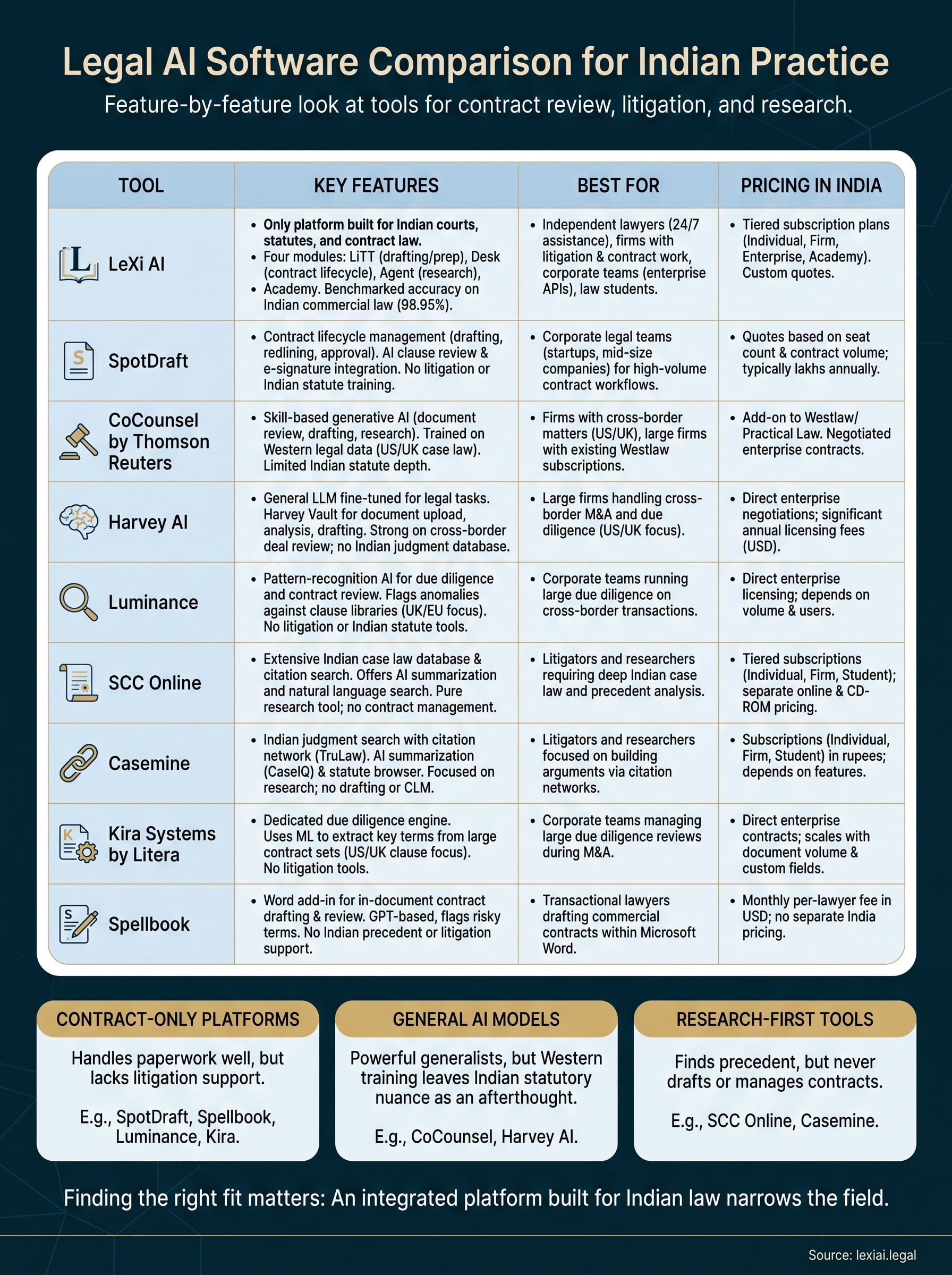
Nine tools, three real categories. Contract-only platforms like SpotDraft, Spellbook, Luminance, and Kira handle paperwork well but stop cold at the courtroom door. General AI models repurposed for law, such as CoCounsel and Harvey, carry Western training that leaves Indian statutory nuance as an afterthought. Research-first tools like SCC Online and Casemine find precedent but never draft or manage contracts. None of these single-purpose tools solve the whole problem for an Indian practice.
Matching your workflow to the right tool matters more than chasing the flashiest feature list. If your firm handles litigation, contracts, and research together and wants Indian statutes trained into every answer rather than bolted on afterward, that narrows the field fast. See how the modules fit your practice by exploring the LeXi AI platform directly, or check the benchmark report before you decide.