

CPC Explained: Structure, Purpose, and Key Provisions
CPC explained in one line: the Civil Procedure Code, 1908 is the law that tells civil courts in India how to conduct a case from the first plaint to final execution. It is not about what rights you have, that is for substantive laws like the Contract Act or Transfer of Property Act. It is about the procedure you follow to enforce those rights in court, covering everything from jurisdiction to appeals.
Most lawyers and law students get confused not by what the CPC says, but by how it is organized. The Act has 158 sections that lay down general principles, and a First Schedule with 51 Orders and hundreds of Rules that spell out the actual mechanics, such as filing a suit, serving summons, or filing an appeal under Order 41. Knowing this split between sections and orders is the first real step to reading the CPC correctly instead of getting lost in cross-references.
This article walks through the CPC's structure, its underlying purpose, and the provisions you will actually use in daily practice, such as Sections 9, 80, and 96, and Orders 7, 39, and 21. Tools like LeXi AI can help you pull the exact provision or precedent fast, but understanding the framework first makes that research far more useful.
Why the CPC matters for every civil case in India
Every civil suit in India, whether it is a property dispute in Bhopal or a commercial claim in the Bombay High Court, runs on the same procedural rulebook. Section 1 of the CPC extends it to the whole of India except the State of Jammu and Kashmir's special provisions that were later harmonized after the 2019 reorganization, and Section 141 stretches its principles to proceedings beyond ordinary suits, including certain writ and tribunal matters where no specific procedure exists. Without this common code, every court could invent its own way of issuing summons, recording evidence, or passing a decree, and no lawyer would ever know what to expect walking into an unfamiliar courtroom.
The CPC applies to almost every civil dispute
Contract disputes, property suits, partnership disputes, recovery of money, injunctions, and declaratory suits all move through the same procedural spine laid out in the CPC. The substantive right might come from the Indian Contract Act, 1872 or the Transfer of Property Act, 1882, but the moment you walk into a civil court, the CPC decides how that right gets tested, argued, and enforced. This is why a lawyer who knows contract law cold but has never opened Order 7 will still struggle to draft a plaint that survives a rejection application under Order 7 Rule 11.
The CPC is not optional background reading, it is the operating system every civil case runs on, regardless of the subject matter.
Special statutes still borrow CPC procedure
Many special laws deliberately import CPC machinery rather than writing their own procedure from scratch. The Companies Act, 2013, the Arbitration and Conciliation Act, 1996, and various tribunal statutes all lean on CPC provisions for things like summoning witnesses, discovery of documents, or execution of orders. Consumer commissions under the Consumer Protection Act, 2019 and the National Company Law Tribunal both draw powers similar to those under the CPC when they need to enforce their own orders.
Here is a quick look at how often the CPC gets referenced by other forums:
| Forum or statute | CPC provisions typically invoked |
|---|---|
| Arbitration and Conciliation Act, 1996 | Sections 27, 36 for evidence and enforcement |
| National Company Law Tribunal | Powers akin to Order 11 (discovery), Order 26 (commissions) |
| Consumer Commissions | Summoning and evidence powers similar to Section 30 |
| Family Courts | Order 32-A for suits relating to family matters |
Grasping this borrowing pattern saves you from treating tribunal practice as a separate universe. If you already know Order 26 for commissions or Section 30 for discovery, you are already halfway prepared for a company law or consumer forum hearing.
The CPC keeps civil litigation predictable
Judges change, benches change, but the sequence of a civil suit rarely does. Filing follows Order 7, the defendant's response follows Order 8, framing of issues follows Order 14, and the trial proceeds under Order 18, right up to judgment under Order 20. Predictability like this lets you plan a litigation timeline for a client with some confidence instead of guessing what a particular judge might do on a given day.
Standardized procedure also means less room for one side to gain an unfair advantage simply because they know a shortcut the other side does not. Section 151, the CPC's provision on inherent powers, exists precisely to let courts fill gaps fairly when the written rules fall silent, not to let procedure become a weapon.
What happens if you ignore the CPC's procedure
Missing a procedural step under the CPC rarely gets forgiven just because your client had a strong case on the merits. Courts have rejected plaints for failing to disclose a cause of action under Order 7 Rule 11, dismissed suits for non-joinder of necessary parties under Order 1, and struck off defenses for failing to file a written statement within the timeline under Order 8 Rule 1. None of these outcomes turn on whether the underlying claim was valid.
Respecting the CPC is not a formality you get to skip when you are confident about the facts. It is the mechanism that decides whether a court ever gets to hear those facts at all. For anyone reading judgments or drafting pleadings regularly, tools like LeXi AI can flag procedural gaps in a draft before a registry clerk or opposing counsel does, but the responsibility to know the CPC's sequence still sits with you.
How to apply the CPC when handling a civil suit
Applying the CPC is not about memorizing 158 sections, it is about knowing which provision governs the stage of the suit you are dealing with right now. Practical application means treating the Code as a checklist you move through step by step, from checking jurisdiction before you draft the plaint to confirming the limitation period before you file it. Lawyers who skip this sequencing end up firefighting objections that a careful reading of Order 7 or Section 9 would have prevented.
Start with jurisdiction before drafting anything
Before you write a single line of the plaint, confirm that the court has pecuniary jurisdiction and territorial jurisdiction under Sections 15 to 20 of the CPC. Filing in the wrong forum wastes months, because the defendant will raise a jurisdiction objection at the earliest opportunity, and courts take these objections seriously under Section 21.
Get jurisdiction wrong at the drafting stage, and every hour spent on the merits afterward is wasted time.
Follow the suit lifecycle in order
Once jurisdiction is settled, the CPC gives you a fixed sequence to follow for the rest of the suit. Working through it in order, rather than jumping ahead, keeps your pleadings and applications aligned with what the court expects at each stage.
- Draft the plaint under Order 7, making sure the cause of action and relief are clearly stated to avoid rejection under Order 7 Rule 11.
- Serve summons on the defendant under Order 5, and track the timeline for filing a written statement under Order 8 Rule 1.
- Frame issues under Order 14 once pleadings are complete, since this defines what actually needs to be proved at trial.
- Lead evidence under Order 18, following the examination and cross-examination sequence the Code lays down.
- Obtain judgment and decree under Order 20, then move to execution under Order 21 if the decree is not honored voluntarily.
Missing any one of these steps, or filing an application at the wrong stage, is what causes most avoidable delays in Indian civil litigation.
Use interim reliefs and inherent powers wisely
While the main suit moves through this lifecycle, you often need protection before the final decree comes through. Order 39 covers temporary injunctions, Order 38 covers attachment before judgment, and Order 26 lets you seek a court commission to record evidence or inspect property when a witness cannot travel. Reach for these only when the facts genuinely support urgency, since courts are quick to spot applications filed as delay tactics.
Section 151, the inherent powers provision, backs up all of this when a specific rule does not cover your situation, but it is meant to fill gaps, not replace the ordinary procedure. Running a search through a platform like LeXi AI before filing any interim application helps confirm which order actually applies and whether recent judgments from your jurisdiction have set a stricter or more relaxed standard for that particular relief.
The structure of the CPC: sections, orders, and schedules
Any CPC explained properly has to start with the fact that it is really two documents stitched together. The main body runs from Section 1 to Section 158 and sets out the broad principles of civil procedure, while the First Schedule contains 51 Orders, each broken into Rules, that spell out the actual mechanics of running a suit. Sections tell you the rule of law, Orders and Rules tell you how to execute it in practice.
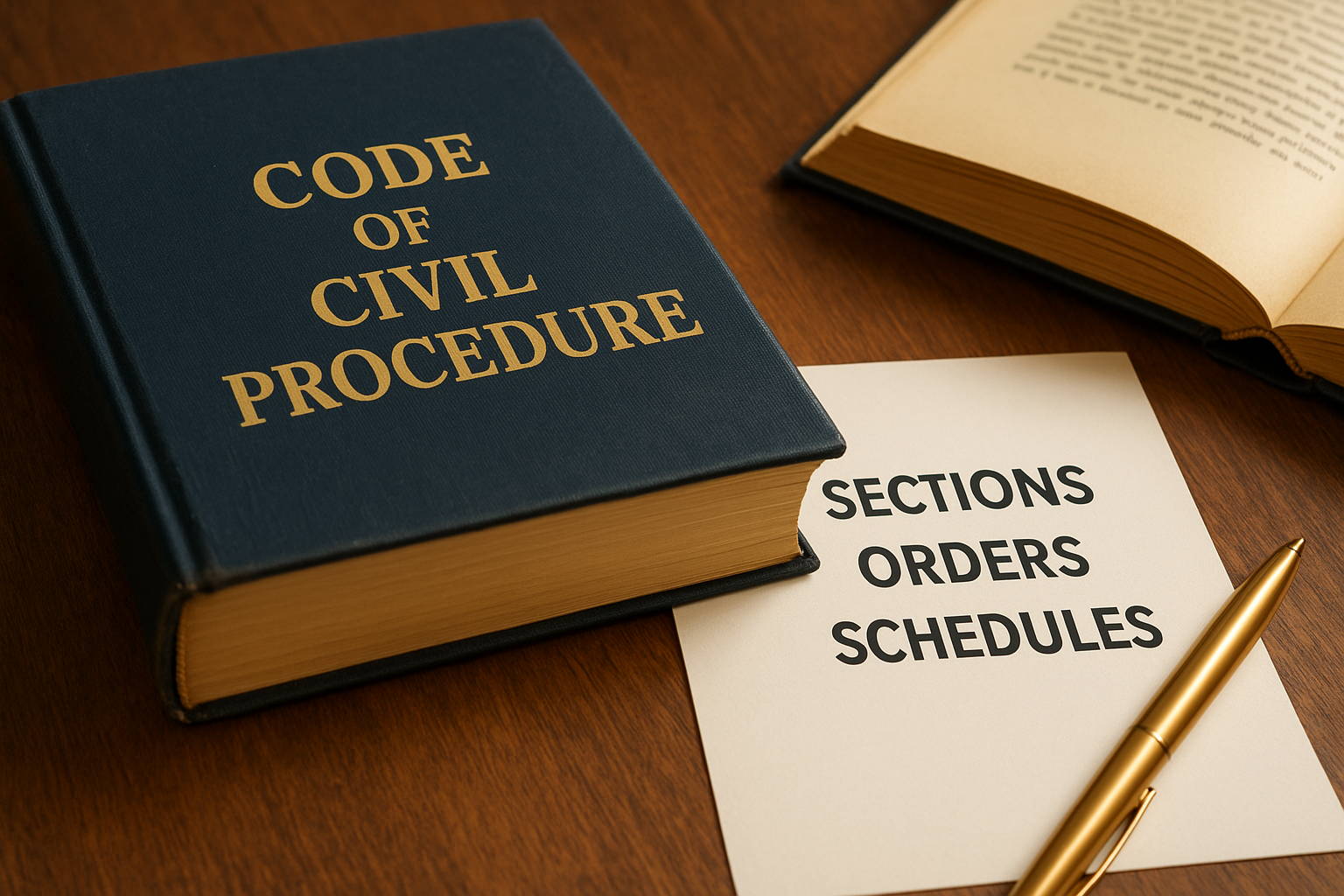
Sections lay down the framework
The 158 sections form the substantive procedural law of the Code, and Parliament alone can change them through amendment. Section 9 tells you which suits a civil court can even entertain, Section 80 requires notice before suing the government, and Section 96 gives you the right of first appeal from an original decree. These sections rarely change year to year because they set the constitutional-style skeleton the rest of the Code hangs on.
If sections are the skeleton of the CPC, Orders and Rules are the muscle that actually moves the case forward.
Orders and Rules supply the mechanics
Orders and Rules in the First Schedule handle the day-to-day drafting and filing work that sections only mention in passing. Order 7 covers how to draft a plaint, Order 8 covers the written statement, and Order 21 alone runs to over 100 rules on execution of decrees, because execution is where most real-world friction happens. Unlike sections, High Courts can amend these rules under Section 122 to suit local practice, which is why filing procedure sometimes differs slightly between, say, the Delhi High Court and the Madras High Court.
| Layer | What it contains | Who can amend it | Example |
|---|---|---|---|
| Sections (1-158) | General principles of procedure | Parliament only | Section 9 (jurisdiction) |
| First Schedule (Orders 1-51) | Detailed rules and forms | Parliament, or High Courts under Section 122 | Order 7 (plaint) |
| Order 21 | Execution procedure | High Courts (local variations common) | Attachment of property |
Schedules beyond the Orders
The First Schedule is not the only schedule the CPC ever carried. A Second Schedule originally dealt with arbitration procedure, but Parliament omitted almost all of it once the Arbitration and Conciliation Act, 1996 took over that field entirely, which is why you will not find much use for it in current practice. What remains functionally important today is the First Schedule and the appendices of forms attached to it, which give you ready templates for plaints, summons, and decrees rather than leaving you to draft from scratch.
Understanding this layered structure changes how you read the Code. Instead of hunting through 158 sections for a drafting answer, you learn to go straight to the relevant Order, then trace back to the governing section only when you need to argue the underlying principle in front of a judge.
Key terms every lawyer should know: decree, judgment, order
Every civil suit ends with the court deciding something, but the CPC treats the words for that decision very differently, and the difference is not academic. Decree, judgment, and order each carry their own definition under Section 2 of the CPC, and each carries different appeal rights. Get the label wrong in a memo or a drafting note, and you can misadvise a client on whether an appeal is even available.

What counts as a decree
Section 2(2) defines a decree as the formal expression of a court's decision that conclusively determines the rights of the parties on the matters in controversy in the suit. A decree can be preliminary or final, and it includes the rejection of a plaint and the determination of a question under Section 144, but it excludes any adjudication from which an appeal lies as an order and any order dismissing a suit for default. The key word is conclusively, since a decree must settle the actual dispute, not just a procedural side issue.
What counts as a judgment
Section 2(9) defines a judgment as the statement given by the judge of the grounds for a decree or order. In practice, the judgment is the reasoning, and the decree is drawn up afterward under Order 20 Rule 6-A to reflect what that reasoning ordered. Lawyers sometimes use the two words interchangeably in conversation, but when you draft an appeal memo, you appeal against the decree, not the judgment, because the judgment is only the explanation behind it.
What counts as an order
Section 2(14) defines an order as the formal expression of any decision of a civil court that is not a decree. Orders typically deal with procedural matters during the suit, things like allowing an amendment of pleadings, deciding an interim injunction application, or dismissing a suit for default without touching the merits. Not every order is appealable, and Section 104 along with Order 43 Rule 1 list out the specific orders you actually have a right to appeal.
A decree settles the dispute, a judgment explains why, and an order handles everything in between, and mixing these up can cost a client their right to appeal.
Why the distinction actually matters in practice
The appeal route you choose depends entirely on which of these three categories your court's decision falls into, so this is not a theoretical distinction you can gloss over.
| Term | CPC provision | Appealable under | Typical example |
|---|---|---|---|
| Decree | Section 2(2) | Section 96 (first appeal) | Suit for recovery of money decreed |
| Judgment | Section 2(9) | Not separately appealable | Reasoning behind a decree |
| Order | Section 2(14) | Section 104, Order 43 Rule 1 (limited list) | Rejection of an amendment application |
A platform like LeXi AI can flag whether a particular trial court decision qualifies as a decree or a merely procedural order before you draft the appeal memo, which saves you from filing under the wrong provision and losing time to a preliminary objection. Knowing these definitions cold also sharpens how you read judgments generally, since courts routinely use this same vocabulary when explaining why an appeal is or is not maintainable.
Jurisdiction, res sub judice, and res judicata explained
Any CPC explained properly has to deal with three ideas that decide whether a court can even hear your case, and whether it should hear it twice. Jurisdiction asks whether this particular court has the authority to try the suit at all. Res sub judice and res judicata ask whether the same dispute is already being tried, or has already been decided, somewhere else. Miss any of these three checks, and a strong case on the merits can still get thrown out before trial even begins.

Jurisdiction is the first gate, not a formality
Sections 15 to 20 of the CPC set the rules for pecuniary jurisdiction and territorial jurisdiction, meaning the court must match both the value of the claim and the place where the cause of action arose or the defendant resides. Section 9 adds a third layer, since it only lets civil courts try suits of a civil nature, excluding matters that another law has expressly or impliedly barred, such as certain election disputes or tax assessments reserved for specific tribunals. Getting any of these three wrong invites an objection under Section 21, and courts do not treat jurisdiction lightly once raised at the earliest opportunity.
A court without jurisdiction cannot rescue even the strongest case, because a decree passed without authority binds no one.
Res sub judice stops parallel trials of the same dispute
Section 10 bars a court from proceeding with a suit if the same matter, between the same parties, is already pending trial in another court of competent jurisdiction in India. This rule exists to stop two courts from reaching conflicting decisions on the same set of facts, and to save both litigants and judges from duplicated effort. If you spot that your client's dispute mirrors a suit already filed elsewhere, raising Section 10 early can pause the second proceeding entirely until the first one concludes.
Res judicata stops the same dispute from being litigated twice
Section 11 goes a step further and applies after a decision, not before one. It bars a court from trying any issue that has already been directly and substantially decided in a previous suit between the same parties by a competent court, even if that earlier decision was on the merits and no appeal was filed. Explanation IV to Section 11 extends this further, treating even matters that could and should have been raised earlier, but were not, as barred.
| Concept | Governing provision | Timing | Effect | |---|---|---| | Jurisdiction | Sections 9, 15-20 | Before filing or at threshold | Determines if the court can try the suit | | Res sub judice | Section 10 | While another suit is pending | Stays the later suit | | Res judicata | Section 11 | After a matter is finally decided | Bars relitigating the same issue |
Checking all three before you file, and again before you argue a preliminary objection, keeps you from wasting a client's money on a suit that a competent court will simply refuse to entertain twice over.
Enforcing foreign judgments and decrees under the CPC
A judgment from a court in London, New York, or Singapore does not automatically bind an Indian court. Sections 13 and 44A of the CPC decide when a foreign judgment carries weight in India, and when it is nothing more than persuasive paper. Get this wrong, and you either waste years trying to execute an order Indian courts will not touch, or you miss a shortcut that could have saved a fresh trial altogether.
Which foreign judgments count as conclusive
Section 13 treats a foreign judgment as conclusive between the same parties, except in six specific situations. It does not bind an Indian court if the foreign court lacked jurisdiction, if the case was not decided on the merits, if it rests on an incorrect view of international law or refuses to recognize Indian law where applicable, if the proceedings were opposed to natural justice, if the judgment was obtained by fraud, or if it sustains a claim founded on a breach of Indian law.
A foreign judgment is conclusive only until one of these six exceptions knocks it down, and courts scrutinize each exception closely before letting a judgment through.
Each exception has generated its own body of case law, and Indian courts routinely examine whether the foreign proceeding gave the defendant proper notice and a real chance to contest the claim before treating the judgment as binding.
Reciprocating territories vs non-reciprocating territories
Section 44A allows direct execution of a decree from a reciprocating territory as if an Indian court had passed it, without filing a fresh suit. The Central Government notifies which countries qualify, and the list includes the United Kingdom, Singapore, and the UAE, among others, under notifications issued by the Ministry of Law and Justice.
| Category | Governing provision | Route to enforce | Example | |---|---|---| | Reciprocating territory | Section 44A | Direct execution petition in an Indian district court | United Kingdom, Singapore | | Non-reciprocating territory | Section 13 read with a fresh suit | File a new suit on the foreign judgment as a cause of action | United States, most others |
If the decree comes from a country not on that notified list, you cannot shortcut the process. You have to file a fresh suit in India treating the foreign judgment itself as the cause of action, and the defendant can still raise any of the Section 13 exceptions as a defense.
Filing a fresh suit on a foreign judgment
When Section 44A does not apply, the fresh suit route under Section 13 becomes the only path, and it needs to be pleaded carefully. You plead the foreign judgment as the basis of the claim, attach a certified copy, and let the defendant contest it on the merits or on one of the six statutory exceptions. Running a quick check through a research tool like LeXi AI on how a specific country's judgments have fared before Indian courts saves you from filing a suit that a settled precedent already forecloses.
Appeals, review, and revision under the CPC
Once a court passes a decree or order, the losing party has three separate routes to challenge it under the CPC, and each one has a different scope, a different forum, and a different chance of success. Appeal, review, and revision are not interchangeable words, and picking the wrong one wastes the limitation period while the correct remedy slips away. Any lawyer explaining CPC explained without covering this trio has left out the part that actually decides whether a client gets a second chance.

First appeal and second appeal
Section 96 gives an aggrieved party the right to a first appeal from an original decree, and this appeal can challenge both facts and law, since the appellate court can re-examine evidence and reverse findings. Section 100 allows a second appeal to the High Court, but only on a substantial question of law, not on facts, which is why High Courts routinely dismiss second appeals that simply repackage a factual dispute already settled twice below.
An appeal on facts stops after the first round, a second appeal only survives if you can point to a genuine question of law.
Order 41 governs the mechanics of filing a first appeal, covering the memorandum of appeal, grounds, and the record to be called from the trial court, and missing any of these formal requirements can get an appeal dismissed at the admission stage itself.
Review under Section 114 and Order 47
Review is not a second appeal in disguise. Section 114, read with Order 47 Rule 1, lets the same court that passed the decree or order reconsider it, but only on narrow grounds: discovery of new and important evidence that was not available despite due diligence, a mistake or error apparent on the face of the record, or any other sufficient reason the courts have interpreted strictly. You file a review petition before the same judge or bench, not before a higher forum, and courts reject most review petitions because litigants try to use them as a backdoor rehearing of arguments already lost.
Revision under Section 115
Revision exists for a different problem entirely, cases where no appeal is available but a subordinate court has still gone wrong on jurisdiction. Section 115 lets the High Court step in when a subordinate court has exercised jurisdiction it did not have, failed to exercise jurisdiction it did have, or acted illegally or with material irregularity while exercising jurisdiction. Revision does not let the High Court re-examine facts or reassess evidence; it is a narrow check on jurisdictional error, not a substitute appeal.
| Remedy | Provision | Forum | Scope | |---|---|---| | First appeal | Section 96, Order 41 | Immediate appellate court | Facts and law | | Second appeal | Section 100 | High Court | Substantial question of law only | | Review | Section 114, Order 47 | Same court | New evidence or apparent error | | Revision | Section 115 | High Court | Jurisdictional error only |
Choosing between these three, and knowing which forum actually has power to grant what you are asking for, is often the difference between a remedy granted in weeks and a petition dismissed as not maintainable.
How amendments have reshaped civil procedure over time
The CPC of 1908 is not the CPC lawyers argue in court today. Parliament has amended it repeatedly to fix delay, and any CPC explained without tracking these amendments gives you a false picture of how litigation actually moves now. The three amendments that matter most for daily practice are 1976, the 1999-2002 pair, and the changes brought in through the Commercial Courts Act, 2015.
The 1976 amendment rebuilt several core provisions
The Code of Civil Procedure (Amendment) Act, 1976 rewrote large parts of the Code to reduce delay and simplify pleadings. It introduced Order 10 in its modern form for examining parties at the first hearing, tightened the rules on framing issues under Order 14, and reworked provisions on injunctions and appeals to cut down on avoidable adjournments. Many of the procedural habits Indian courts follow today, such as recording admissions early to narrow the dispute, trace directly back to this one amendment.
The 1976 amendment did not just tweak language, it changed how early in a suit a court is expected to narrow down what is actually in dispute.
The 1999 and 2002 amendments targeted trial delay directly
Following recommendations from the Law Commission, the 1999 and 2002 amendments went after the two biggest sources of delay: written statements and oral arguments. Order 8 Rule 1 now sets a firm outer limit of 90 days for filing a written statement, and Order 18 was reworked to let courts record evidence through commissioners more often instead of tying up a judge's time. Section 89 was also introduced in this period, pushing parties toward mediation, arbitration, and conciliation before a suit runs its full course.
Commercial Courts Act brought a faster track for business disputes
The Commercial Courts Act, 2015 amended the CPC specifically for commercial disputes above a notified value, and the practical effect has been significant for anyone handling business litigation. It introduced summary judgment procedures, mandatory pre-institution mediation under Section 12A, and stricter timelines for written statements and case management hearings.
| Amendment | Year | Main change | Practical effect | |---|---|---| | CPC Amendment Act | 1976 | Rewrote Order 10, 14 | Faster issue framing, early admissions | | CPC Amendment Act | 1999 & 2002 | 90-day cap on written statement, Section 89 | Reduced trial delay, pushed ADR | | Commercial Courts Act | 2015 | Summary judgment, Section 12A mediation | Faster resolution for commercial suits |
For a litigator, tracking which version of an Order applies to your specific forum matters because commercial courts, ordinary civil courts, and certain tribunals do not all run on identical timelines anymore. Reading a judgment without checking which amendment was in force at the time can lead you to cite a rule that no longer exists in that form. A research tool like LeXi AI helps flag when a cited provision has since been amended, which saves you from building an argument on a version of the Code that a court will no longer recognize.
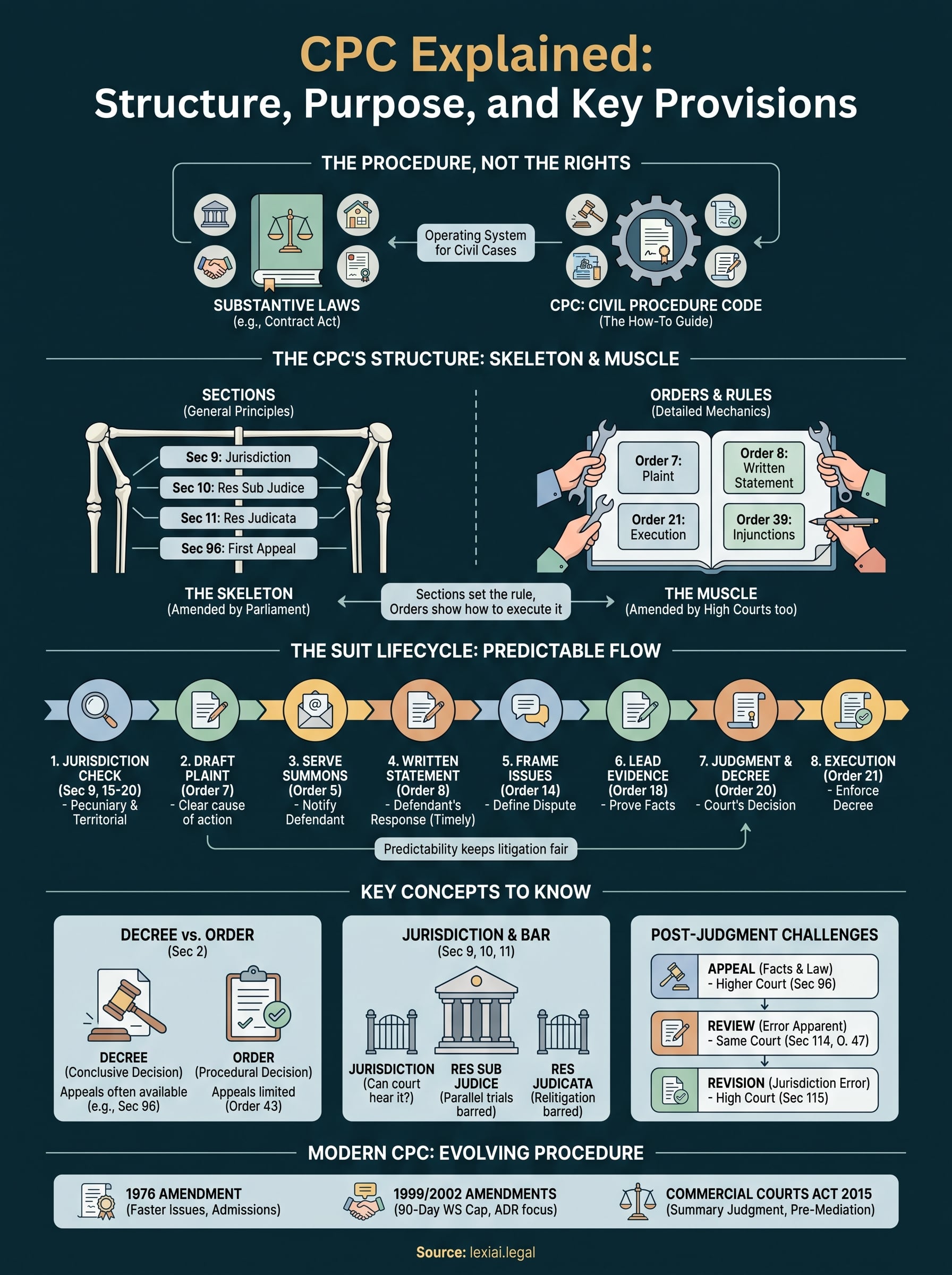
Making the CPC part of daily practice
The CPC explained in full comes down to one habit: check the stage of your suit, then check the provision that governs that stage. Sections give you the principle, Orders and Rules give you the mechanics, and the amendments tell you which version of that mechanics actually applies today. Lawyers who treat the Code this way stop losing time to preliminary objections and start spending it on the merits, which is where a case is actually won.
None of this replaces reading the Code itself, but a good research layer speeds up how fast you connect a fact pattern to the right provision. If you want to see how that works in practice, including how fast a query on jurisdiction or execution resolves against verified sources, sign up for LeXi AI and run your next drafting or research task through it before you file.