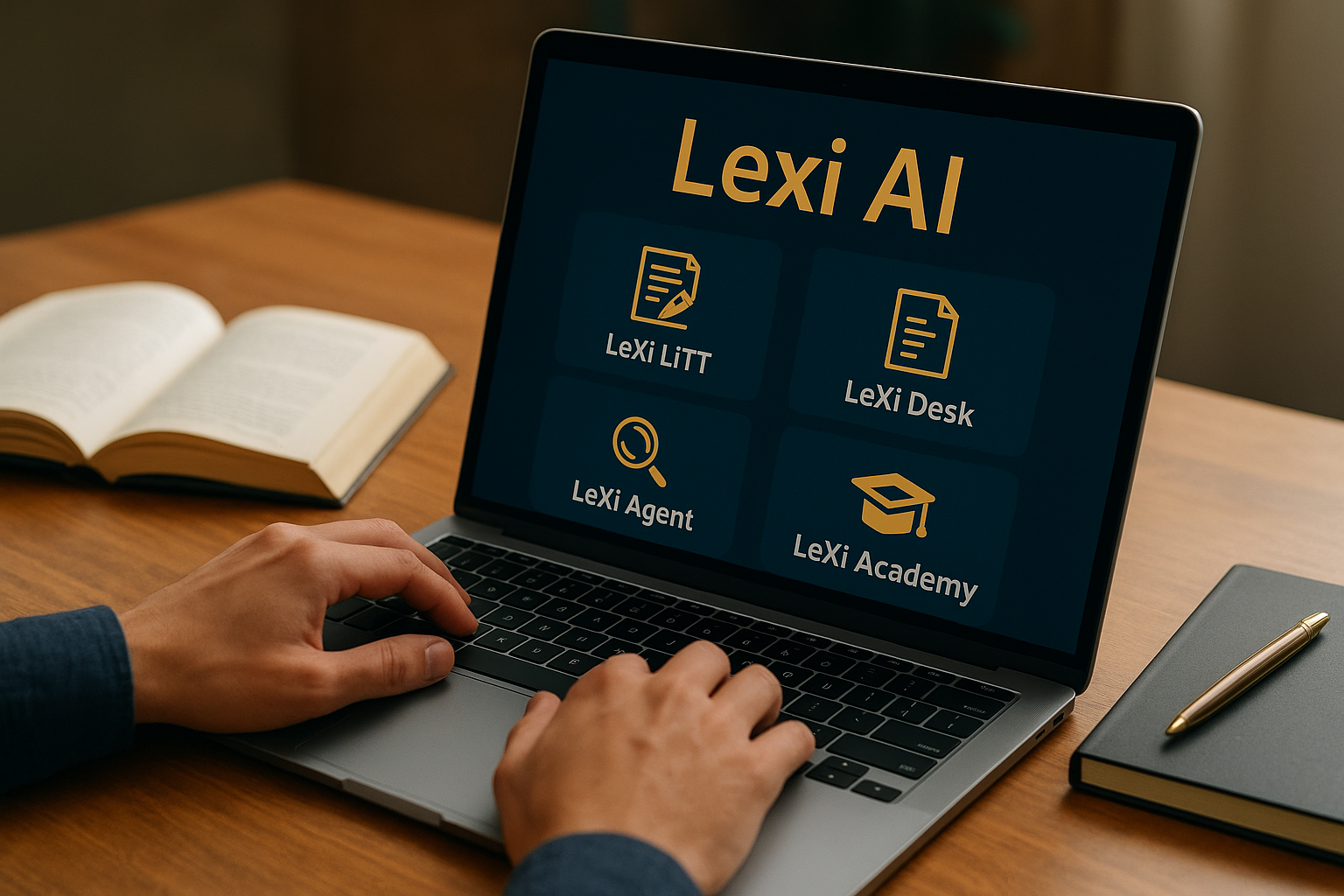

8 Best AI Legal Research Tools for Indian Lawyers in 2026
If you are still searching SCC Online or Manupatra case by case, you already know the problem. AI legal research tools now read a fact pattern, pull relevant judgments, and summarize a 400 page file in minutes, work that used to take a junior associate an entire day. That gap between manual research and AI assisted research is exactly why so many Indian lawyers are switching tools in 2026.
This article answers a simple question: which AI legal research platforms actually work for Indian law right now. Not every tool trained on US case law handles the Indian Evidence Act or Supreme Court precedent well, so accuracy on Indian statutes matters more than flashy features. I have looked at tools built for Indian commercial law, litigation prep, and citation verification, not generic chatbots repackaged as legal software.
Below, I cover eight tools, including LeXi AI's own research and case strategy modules, and break down what each one does well, where it falls short, and who it actually suits. Independent lawyers, chambers, and corporate legal teams will find different tools useful depending on caseload and budget, so I have kept the comparisons practical rather than promotional.
1. LeXi AI
LeXi AI sits at the top of this list because it was built specifically for Indian legal work, not adapted from a US product after the fact. The platform combines legal research, contract lifecycle management, and litigation prep into one connected system, so you are not switching between four different logins to draft a plaint, check a precedent, and review a contract clause. On the AIBE 20 legal reasoning benchmark, LeXi AI scored 98.95% accuracy on statutory interpretation and case analysis tasks tied to Indian commercial law, ahead of general models like GPT 5.5 and Gemini 3.1 Pro tested on the same dataset.

Key features
The research engine, called LeXi Agent, handles precedent analysis and drafting acceleration with verified sources pulled directly from judgment databases, so you are not left guessing whether a cited case actually says what the AI claims it says. Litigation teams get LeXi LiTT, a module built for case strategy and courtroom preparation, including summarizing dense case files in minutes instead of hours.
- Instant judgment search across verified databases, with source links attached to every result
- Case file summarization that condenses files of 400 pages or more into a working brief
- Clause risk analysis and clause generation through LeXi Desk for contract heavy practices
- Legal translation for filings that need to move between English and regional languages
- Enterprise APIs for firms that want to build their own AI workflows on top of LeXi's models
- AI Academy modules for law students learning research and drafting alongside practicing lawyers
A research tool is only as good as its citations, and LeXi AI ties every result back to a verified source instead of asking you to trust a summary.
Who it is for
LeXi AI works best for litigation focused lawyers and chambers who need case strategy support alongside research, and for corporate legal teams juggling contract review with occasional court filings. Independent lawyers who bill by outcome rather than by hour will notice the time savings fastest, since faster prep directly protects billable margins. Enterprises building custom legal tooling can also use the API layer rather than the consumer facing product.
Pricing
LeXi AI does not publish a flat public rate card because usage patterns vary so much between a solo practitioner and a 200 lawyer firm. Independent lawyers and small chambers typically start on a subscription tier scoped to research and drafting volume, while firms and enterprises negotiate custom plans that bundle LeXi Desk, LeXi Agent, and API access together. If you want exact numbers for your practice size, request a demo directly through lexiai.legal rather than relying on third party estimates, since enterprise pricing depends on seat count and API call volume.
2. jhana.ai
jhana.ai built its name on courtroom research, and that focus shows in how the product is structured. The tool leans heavily on conversational search for Indian case law, letting a lawyer type a fact pattern in plain English and get back relevant judgments instead of a list of keyword matches. It also handles document drafting, though the research side is where it earns most of its user base among litigators.
Key features
Users get a chat style interface for querying case law, along with drafting support for pleadings and legal notes. The platform pulls from Indian court judgments and highlights the passages most relevant to the query rather than dumping the full text on you.
- Conversational query interface for case law search
- Drafting assistance for pleadings, notices, and legal opinions
- Judgment summaries generated alongside search results
- Support for both civil and criminal matter research
A chat style research tool only earns trust once you check its citations against the original judgment, every time, not just occasionally.
Who it is for
Litigators who prefer typing a question over running Boolean searches will find jhana.ai's interface faster for day to day court prep. Solo practitioners and small litigation teams handling a high volume of matters tend to get the most value, since the conversational format cuts down time spent refining search strings. It suits lawyers who want quick answers during a hearing more than firms running large scale contract or compliance work.
Pricing
Pricing is subscription based and scales with usage, though jhana.ai does not publish a fully detailed rate card on its site. Independent lawyers can typically start on a lower tier plan, while firms with multiple users negotiate seat based pricing directly with the company. Check the current plan details on their website before committing, since legal AI pricing in this segment tends to shift as products add features.
3. Prism AI by IndianKanoon
IndianKanoon has been the free backbone of Indian legal research for over a decade, and Prism AI is its attempt to add AI search on top of that existing judgment database. Since IndianKanoon already indexes lakhs of judgments from the Supreme Court, High Courts, and tribunals, Prism AI's biggest strength is the sheer depth of its underlying case law repository. Lawyers who already use IndianKanoon for free searches will find the AI layer a natural upgrade rather than a switch to an unfamiliar database.

Key features
Prism AI lets you query the IndianKanoon database in natural language instead of relying purely on keyword search, and it returns judgment excerpts tied to the original source. It also supports citation lookups, so checking whether a judgment has been overruled or followed becomes faster than manually tracing citation chains.
- Natural language search across the full IndianKanoon judgment archive
- Citation tracing to check how later judgments treat a precedent
- Coverage extending to tribunal orders, not just constitutional courts
- Direct links back to full judgment text for verification
A search tool built on the largest free Indian case law archive still needs you to verify each citation before it goes into a filing.
Who it is for
Prism AI suits lawyers and researchers who already rely on IndianKanoon and want faster natural language search without abandoning a familiar database. It works well for academic researchers and litigators doing broad precedent sweeps across obscure tribunals, where coverage matters more than drafting or contract features. It is not built for contract lifecycle work or courtroom strategy, so firms needing those functions will still need a second tool.
Pricing
IndianKanoon's core search remains free, and Prism AI's premium features are offered through paid subscription tiers layered on top of that free base. Exact pricing depends on which AI features and usage limits you need, so check current tiers on IndianKanoon's site directly before subscribing. Solo practitioners on tight budgets often start with the free tier and upgrade only once AI search becomes part of their daily workflow.
4. AI Lawyer
AI Lawyer markets itself as a general purpose legal assistant rather than a India specific research platform, and that broader scope shows in both its strengths and its gaps. Built to serve multiple jurisdictions, the tool applies the same chat based interface to Indian statutes, US case law, and UK precedent, so cross border research becomes possible without switching apps. Litigators handling matters with an international element, such as arbitration or cross border contracts, sometimes reach for it precisely because it does not lock them into one country's case law alone.
Key features
The core of AI Lawyer is a conversational assistant that answers legal questions, drafts basic documents, and summarizes uploaded files across several jurisdictions. It supports document upload and summarization, letting a lawyer paste in a contract or judgment and get a plain language breakdown back within seconds.
- Multi jurisdiction chat assistant covering India, the US, and the UK
- Document upload for summarization and clause review
- Basic drafting templates for common legal documents
- Quick answer mode for statutory definitions and procedural questions
A multi jurisdiction tool trades depth on Indian statutes for breadth across countries, so verify every Indian citation separately.
Who it is for
AI Lawyer suits solo practitioners and law students who need a quick reference tool for general questions rather than deep Indian precedent research. It works reasonably well for lawyers handling cross border matters who need a rough first pass on foreign law before consulting local counsel. Firms doing high volume Indian litigation will likely find the Indian statutory coverage too shallow compared to tools built specifically for Indian courts.
Pricing
AI Lawyer offers a free tier with limited daily queries, along with paid subscription plans that unlock higher usage limits and document upload features. Pricing sits toward the affordable end of this list, which makes it accessible for students and independent lawyers testing AI research tools for the first time. Check current plan limits on their site, since free tier caps tend to change without much notice.
5. LawCentral.ai
LawCentral.ai positions itself as a research and drafting workspace for lawyers who want everything tied to one case file, rather than a standalone search box. The platform organizes case level research alongside drafting tools, so a lawyer working a matter can pull precedents, draft a reply, and store notes without exporting anything to a separate document. It targets Indian litigation and corporate practice equally, which sets it apart from tools built for one niche alone.
Key features
Central to the product is a workspace that links research results directly to the matter you are working on, instead of treating every search as a one off query. Drafting support sits alongside the research panel, so citations found during a search can be pulled straight into a draft without retyping case names or citations.
- Matter based workspace linking research, notes, and drafts in one place
- AI powered case law search with citation extraction
- Drafting templates that pull in cited judgments automatically
- Collaboration features for teams working the same file
Tying research to the matter file saves the time lawyers usually lose copying citations between tabs.
Who it is for
LawCentral.ai suits small to mid sized litigation firms that want research and drafting under one roof without paying for an enterprise contract suite they do not need. Teams that handle several ongoing matters at once benefit most, since the workspace structure keeps each file's research separate and searchable later. Solo practitioners who only need occasional quick lookups may find the matter based structure more setup than they actually need.
Pricing
LawCentral.ai runs on subscription tiers priced per user, with higher tiers unlocking collaboration features and larger research quotas. There is no fully published enterprise rate card, so firms above a certain seat count should expect a custom quote. Check the current tier breakdown on their site before committing, since research quota limits vary by plan and matter.
6. Legitquest
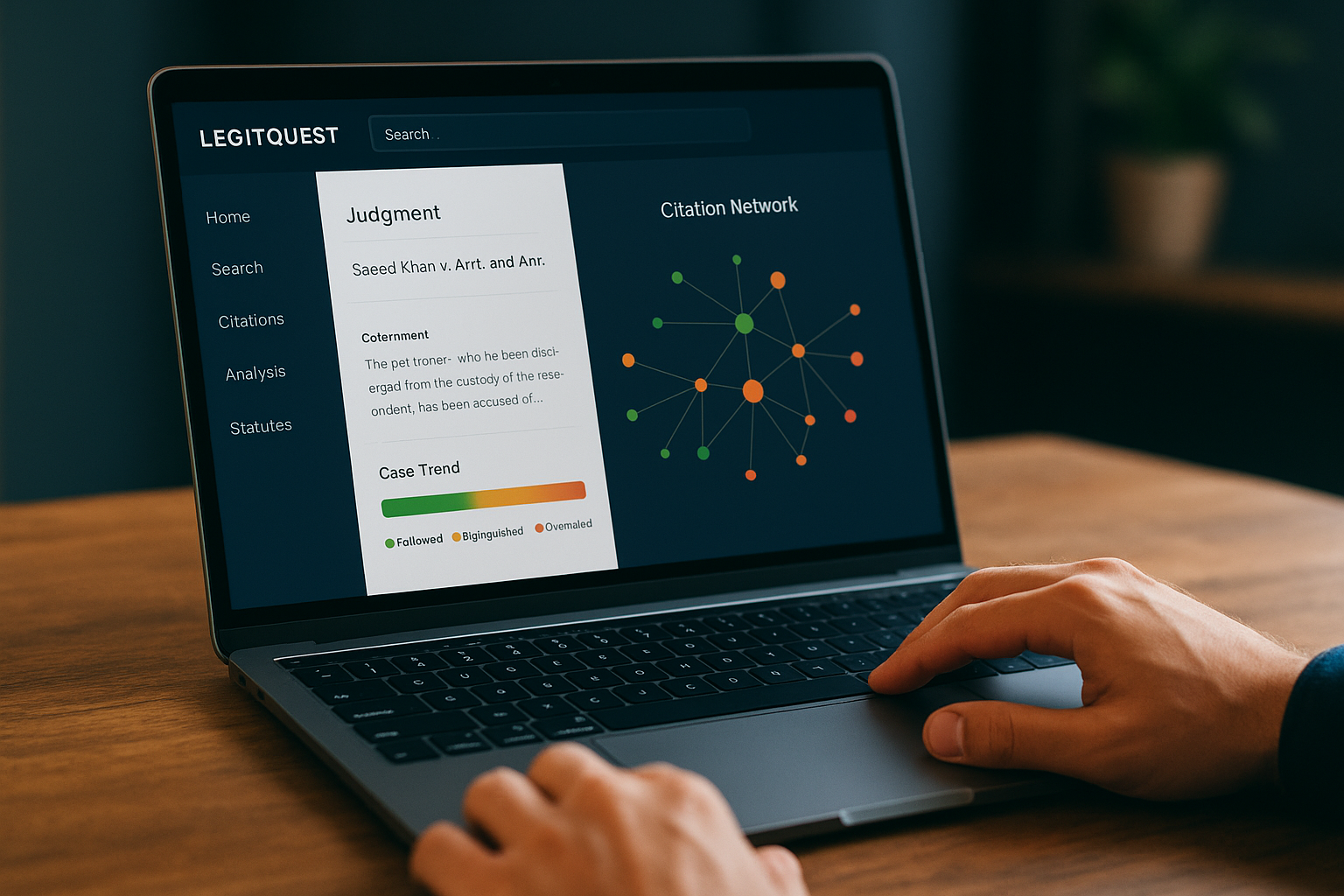
Legitquest built its reputation as a citation and case law database before it added AI search on top, and that legal publishing background still shows in how carefully the platform structures its results. Focused mainly on Indian case law and statutes, the tool traces judgment relationships through a visual citation network, so you can see at a glance which precedents a court relied on and which ones later got overruled. Firms doing heavy litigation research often reach for Legitquest specifically because that citation mapping saves the manual work of tracing a precedent chain by hand.
Key features
Core to the product is Case Trend, a feature that visualizes how a judgment has been cited over time, flagging whether later benches followed, distinguished, or overruled it. Natural language search sits alongside this, letting a lawyer type a fact pattern and pull relevant judgments without memorizing exact keyword combinations.
- Visual citation network showing how precedents connect across courts
- Case Trend analytics tracking whether a judgment remains good law
- Natural language search across Supreme Court and High Court judgments
- Statute annotations linking sections to relevant case law
Seeing a citation network on screen catches overruled precedent faster than reading footnotes one by one.
Who it is for
Litigators handling appeals and precedent heavy matters get the most value from Legitquest, since tracing how a judgment has aged matters more in appellate work than in routine filings. Researchers building written opinions or academic papers also benefit from the citation mapping, since it surfaces relationships a plain keyword search would miss entirely.
Pricing
Subscription plans run on tiered access, with higher tiers unlocking full Case Trend analytics and broader database coverage. Solo practitioners can start on a basic plan, while firms needing multi user access negotiate directly with Legitquest for seat based pricing. Confirm current tier limits on their site, since coverage and pricing structures get revised periodically.
7. Cetient
Cetient positions itself as a research tool built around speed, promising near instant case law retrieval for lawyers who cannot afford to wait on slow database queries during a hearing prep sprint. The platform focuses on Indian judgment search across Supreme Court and High Court decisions, pairing that with a citation checker that flags whether a precedent still holds good law. Compared to older legal databases, Cetient markets itself as the leaner option, built for lawyers who want quick answers rather than a full research suite.
Key features
Cetient's search engine accepts plain language queries and returns judgments ranked by relevance rather than by date alone, which cuts down the scrolling that keyword search usually demands. It also includes a citation validity check, so a lawyer can confirm a precedent has not been overruled before citing it in a filing.
- Natural language search across Supreme Court and High Court judgments
- Citation validity checks flagging overruled or distinguished precedent
- Quick summary snippets attached to each search result
- Bookmarking and folder tools for organizing research by matter
Speed only matters if the citations underneath still hold up in court, so treat every quick result as a starting point, not a final answer.
Who it is for
Cetient suits solo practitioners and small litigation teams who need fast turnaround on case law searches without the learning curve of a full research workspace. Lawyers preparing for hearings on short notice will find the interface quick to pick up, since there is little setup required before running a first search. Firms doing contract work or large scale document review will not find much here, since Cetient stays focused on case law rather than drafting or clause analysis.
Pricing
Cetient runs on a straightforward subscription model, with a lower tier for individual lawyers and a higher tier for firms needing multiple seats. There is no free tier beyond a limited trial period, so budget conscious solo practitioners should test the trial before committing to an annual plan. Confirm current pricing directly on their site, since subscription tiers in this space get revised often as new features roll out.
8. Thomson Reuters CoCounsel
Thomson Reuters built CoCounsel on top of a general purpose language model, then trained it on legal workflows across contract review, deposition prep, and legal research. Global firms with Indian offices sometimes already have access through an existing Thomson Reuters license, since the company also runs Westlaw and Practical Law in other jurisdictions. Coverage of Indian statutes and case law stays thinner than tools built ground up for Indian practice, so treat CoCounsel as a general research assistant rather than an Indian litigation specialist.
Key features
CoCounsel handles document review, deposition summary drafting, and legal research queries through a conversational interface, plus contract analysis for flagging risky clauses. It also connects to Thomson Reuters databases where a firm already subscribes to Westlaw, which helps for cross border matters involving US or UK law.
- Conversational legal research assistant across multiple practice areas
- Contract review and clause risk flagging
- Deposition and case file summarization
- Integration with existing Thomson Reuters subscriptions where applicable
A global research assistant helps most on cross border matters, not on the fine detail of Indian statutory interpretation.
Who it is for
CoCounsel suits large firms and enterprises already inside the Thomson Reuters ecosystem, particularly those handling cross border transactions or US and UK linked disputes. Solo practitioners and small chambers focused purely on Indian litigation will likely find the Indian case law depth thinner than tools built specifically for that market.
Pricing
Thomson Reuters does not publish flat pricing for CoCounsel, and firms negotiate enterprise licensing directly with the sales team based on seat count and existing subscriptions. Expect costs well above most tools on this list, since CoCounsel targets large firms rather than independent practitioners. Request a quote through Thomson Reuters directly if your firm already runs Westlaw, since bundled pricing sometimes brings the effective cost down.
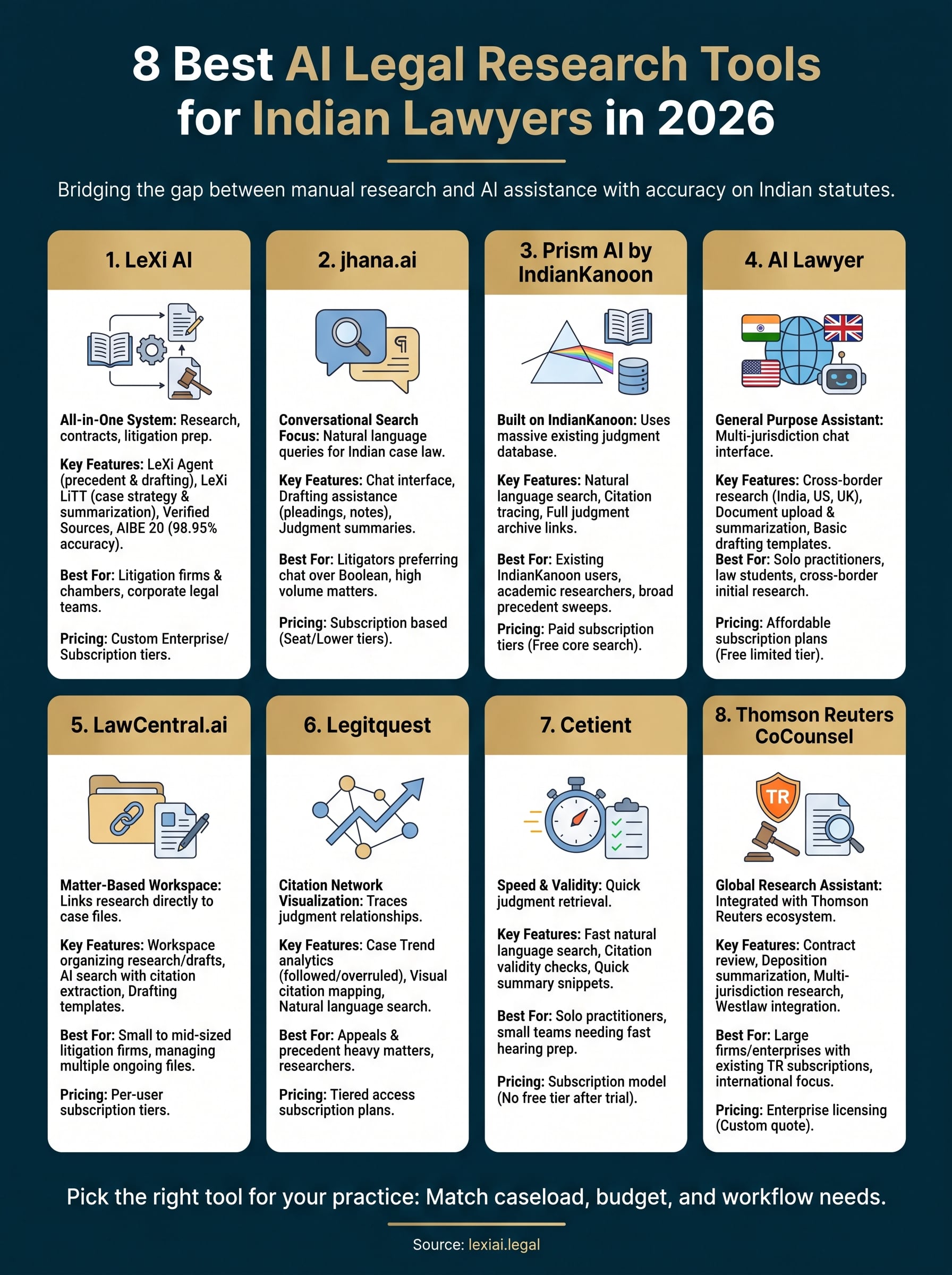
Picking the right tool for your practice
Match the tool to your caseload, not the marketing page. A solo litigator running quick hearing prep needs speed and citation checks, not an enterprise contract suite. A corporate team drowning in clause review needs risk flagging more than a chat interface. Budget and practice type should drive the decision far more than which tool ranks highest on a benchmark chart.
If your work spans litigation, research, and contracts at once, running three separate logins wastes time you could bill instead. That is the gap LeXi AI was built to close, with research, drafting, and case strategy sitting inside one connected system rather than three disconnected subscriptions.
Read the benchmark data yourself before you decide anything. Check the AIBE 20 legal reasoning results and see how the numbers hold up against whatever tool you are currently using.