

Contract Lifecycle Management Software Pricing: What It Costs in 2026
Most vendors will not give you a straight number until you get on a call, and that alone tells you pricing is negotiable and often inflated for buyers who do not come prepared. Contract lifecycle management software pricing in India typically ranges from around 15,000 rupees per user per month for basic drafting and storage tools to well over 1.5 lakh rupees per month for enterprise platforms with clause risk analysis and API access. The gap between those numbers depends less on brand name and more on what the tool actually does for your team.
If you are budgeting for CLM software or comparing quotes from two or three vendors, you need to know what drives the cost, not just the sticker price. Per-seat licensing, document volume, AI-assisted drafting features, and implementation support all move the number up or down significantly.
This article breaks down actual pricing tiers you will encounter in 2026, the factors that push costs higher, and what a fair price looks like for a solo practitioner versus a corporate legal team. We also cover where platforms like LeXi Desk fit into this pricing picture, so you can compare features against cost rather than guessing.
Why contract lifecycle management pricing varies so much
Talk to five CLM vendors and you will get five different pricing structures, not just five different numbers. Some charge per seat, some charge per document processed, and a few enterprise platforms quote a flat annual fee regardless of headcount. This structural difference, more than any single feature, explains why one quote looks like 20,000 rupees a month and another looks like 2 lakh rupees a month for what seems like the same product on paper.
Pricing models: per-seat, per-document, and flat enterprise fees
Vendors pick a pricing model based on who they are selling to, not based on what is fair for your workflow. A three-partner firm drafting fifty contracts a month gets punished by per-document pricing if volume spikes during a deal closing. A hundred-lawyer firm gets punished by per-seat pricing if half the team barely touches the contract module.

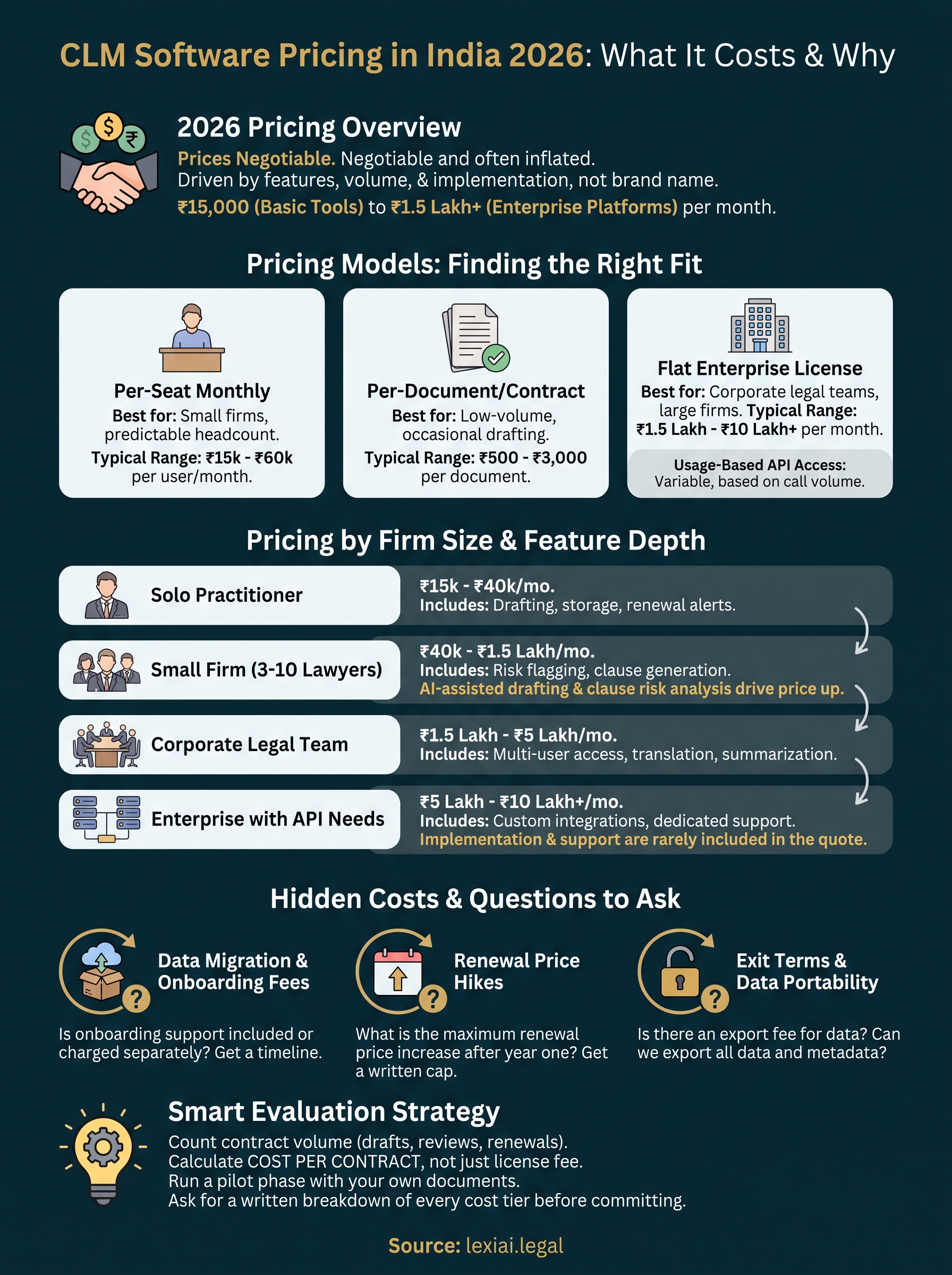
| Pricing Model | Best For | Typical Range (India) |
|---|---|---|
| Per-seat monthly | Small firms, predictable headcount | ₹15,000 to ₹60,000 per user/month |
| Per-document or per-contract | Low-volume, occasional drafting | ₹500 to ₹3,000 per document |
| Flat enterprise license | Corporate legal teams, large firms | ₹1.5 lakh to ₹10 lakh+ per month |
| Usage-based API access | Enterprises building custom workflows | Variable, based on call volume |
Feature depth changes the number more than brand
Brand name matters less than what sits under the hood. A tool that only stores documents and lets you set renewal reminders will always cost less than one that runs clause risk analysis, flags indemnity exposure, or generates redlines automatically. The jump from basic storage to AI-assisted drafting and risk flagging is usually where the price doubles or triples.
The single biggest driver of CLM pricing is not the vendor's reputation, it is how much actual legal reasoning the software performs on your behalf.
Ask any vendor to walk you through exactly which clauses their risk detection covers, whether it is indemnity, liability caps, termination triggers, or all three. A platform that flags only three clause types should not cost the same as one that reviews twenty.
Implementation and support are rarely included in the quote
Custom integrations with your existing document management system, staff training sessions, and dedicated account support almost never show up in the headline price. Enterprises building on top of a CLM platform through API access should expect separate development costs on top of the subscription fee, since integrating contract workflows into internal systems takes engineering time regardless of how polished the vendor's dashboard looks.
Support tiers also vary more than buyers expect. A basic plan might give you email support with a 48-hour response window, while an enterprise plan includes a dedicated account manager and same-day turnaround on urgent drafting queries. If your firm handles time-sensitive litigation filings, that difference in support speed is worth paying for, and it is worth asking about explicitly before you sign anything, not after your first urgent request goes unanswered for two days.
How to evaluate CLM pricing for your organization
Start by counting how many contracts your team actually touches in a month, not how many seats you think you need. Most firms overestimate seat count and underestimate document volume, which leads them straight into the wrong pricing model. Contract volume should drive your evaluation before you even look at feature lists, because a mismatch here inflates your bill regardless of which vendor you pick.
Match pricing to your actual contract volume
Write down your last three months of contract activity: how many drafted, how many reviewed, how many renewed. This number tells you whether per-seat pricing or per-document pricing fits your firm better, and it stops you from paying for capacity you never use.
- Count drafts, reviews, and renewals separately for the last quarter
- Flag any seasonal spikes, such as year-end renewals or deal closings
- Compare that volume against each vendor's pricing tier, not their marketing page
Calculate cost per contract, not cost per license
Divide the monthly quote by your actual contract volume to get a real cost per contract. A plan that looks expensive at 80,000 rupees a month can be cheaper per document than a 20,000 rupee plan if your volume is high enough to justify it.
The number that matters is cost per contract handled, not the monthly invoice total.
This single calculation exposes vendors who price aggressively on the surface but charge extra for every clause type or document format beyond the basics.
Test before you commit to a contract
Running a pilot phase with your own documents, not vendor demo files, tells you more about pricing fit than any sales call. Ask for a two-week trial where your team drafts and reviews real contracts, then measure how much time it actually saved against your current process.
Request a written breakdown of every cost tier before the trial ends, including what happens if you exceed your document quota mid-month. Vendors who hesitate to put pricing tiers in writing are usually the ones planning to renegotiate upward once you are dependent on their platform. That hesitation alone tells you something about how the relationship will go after year one.
What CLM software actually costs in India
Indian pricing for contract lifecycle management software breaks down clearly once you group buyers by size rather than by feature list. A solo practitioner drafting thirty contracts a month pays a fraction of what a hundred-person corporate legal team pays, but the gap is not just headcount, it reflects how much AI-assisted drafting and risk analysis each tier actually gets access to.
Solo practitioners and small firms
Lawyers working alone or in two-to-three-person setups usually land in the 15,000 to 40,000 rupee per month range for a single seat with basic drafting, storage, and renewal tracking. Add clause risk analysis or automated redlining, and that number climbs toward 50,000 to 70,000 rupees per month, since risk detection requires more computing power on the vendor's end.
Corporate legal teams and enterprises
Enterprises running contract volume across departments almost never pay per seat. Most negotiate flat licenses starting around 1.5 lakh rupees per month and scaling past 10 lakh rupees for organizations that need API access to build custom workflows into their existing legal or procurement systems.
| Buyer Type | Monthly Cost (India) | What It Usually Includes |
|---|---|---|
| Solo lawyer | ₹15,000 to ₹40,000 | Drafting, storage, renewal alerts |
| Small firm (3 to 10 lawyers) | ₹40,000 to ₹1.5 lakh | Risk flagging, clause generation |
| Corporate legal team | ₹1.5 lakh to ₹5 lakh | Multi-user access, translation, summarization |
| Enterprise with API needs | ₹5 lakh to ₹10 lakh+ | Custom integrations, dedicated support |
A fair benchmark is roughly 60,000 to 90,000 rupees per month for a mid-sized firm that wants AI-assisted drafting without paying enterprise rates.
Firms sitting between solo practice and full corporate legal departments often overpay because they default to enterprise quotes out of caution. Platforms like LeXi Desk price contract lifecycle features, including clause risk analysis and document summarization, closer to the small-firm tier while still covering the drafting volume a growing chamber actually needs. That middle tier is where most Indian law firms belong, yet it is the tier vendors mention least during a first sales call.
Hidden costs and questions to ask before signing
Every CLM quote hides at least one cost that only shows up after the contract is signed. Migration fees, renewal price hikes, and exit penalties rarely appear on the pricing page, and vendors are not obligated to volunteer them unless you ask directly. Treat the sales call as a negotiation, not a formality, because the questions you skip now become the invoice surprises you deal with in year two.
Data migration and onboarding fees
Moving your existing contracts, templates, and clause libraries into a new platform takes real work, and vendors often bill it separately from the subscription. Ask whether onboarding support is included in the quoted price or charged as a one-time setup fee, since that number can run into tens of thousands of rupees for firms with large document archives. Get the onboarding timeline in writing too, because a vendor that promises a two-week migration but delivers in six weeks costs you billable hours regardless of what the software itself charges.
Renewal price hikes after year one
Many vendors offer a discounted first-year rate to win the deal, then raise prices sharply at renewal once your firm depends on the platform. Request a written cap on renewal increases before you sign, ideally tied to a fixed percentage rather than left open to negotiation.
Ask for the renewal price in writing before you sign, not after your first year ends.
Exit terms and data portability
Find out what happens to your contract data if you switch vendors later. Some platforms charge an export fee to release your documents in a usable format, and others lock certain metadata, like clause tags or risk scores, inside their own system entirely.
Before signing anything, get answers to these questions in writing:
- What counts as one document or one seat under this pricing tier?
- What happens if we exceed our monthly quota mid-cycle?
- Is onboarding included, and what is the guaranteed timeline?
- What is the maximum renewal price increase after year one?
- Can we export all contract data and metadata if we leave?
Vendors who answer these clearly are usually the ones worth trusting with your firm's contract data long term.
Getting the pricing conversation right
Pricing for contract lifecycle management software is not fixed, it is negotiated based on how much homework you did before the call. Know your contract volume, ask about hidden fees upfront, and match the pricing model to your actual workflow instead of accepting whatever tier the vendor pushes first. The firms that overpay are almost always the ones that skipped this step and went straight to signing.
Run the numbers on cost per contract, not just the monthly invoice, and get renewal terms in writing before you commit. That single habit saves most Indian law firms lakhs of rupees over a three-year contract.
If you want to see where AI-assisted drafting and clause risk analysis actually fit into a fair pricing structure, check the LeXi AI pricing page before your next vendor call.