

Legal Practice Management Software Comparison: Top 7 Options
Most Indian law firms end up running three or four disconnected tools, one for drafting, one for billing, one for research, and another for case tracking. That patchwork adds cost and slows down every matter. This legal practice management software comparison looks at seven platforms that Indian lawyers and firms actually use, so you can match features and pricing to how your practice actually works instead of relying on vendor claims.
The short answer: no single tool fits every firm size or practice area, but the differences come down to a handful of factors. Look at case management depth, billing and trust accounting, document automation, integration with Indian court and filing systems, and total cost per seat as your firm scales.
This article breaks down each of the seven options by core features, pricing tiers, and the type of firm each one suits best, from solo practitioners to enterprise legal teams. Along the way, we also note where connected platforms like LeXi AI add drafting, research, and contract intelligence in one place, so you see where a unified workflow genuinely saves time versus stitching separate apps together. Whichever tool you land on, this legal practice management software comparison should leave you with a clear shortlist rather than seven open tabs.
1. What to look for in legal practice management software
Before comparing any vendor, work out what your firm actually needs from legal practice management software. A three-partner litigation practice in Delhi needs something very different from a ten-lawyer commercial firm in Mumbai handling contract-heavy transactional work. Match the tool to your caseload, not the other way around, and keep this legal practice management software comparison anchored to your own billing model rather than a vendor's feature list.

Case and matter management
Check whether the platform tracks matters the way Indian litigation actually runs, with hearing dates, cause list updates, and document versioning tied to each case. Some tools built for US firms assume a single court system and flat fee structures, which does not translate well to Indian civil or criminal procedure timelines.
Billing and trust accounting
Most Indian firms still bill on a mix of retainers, hourly rates, and lump-sum fees per matter. Look for software that handles multi-currency billing if you work with foreign clients, and one that generates GST-compliant invoices without manual rework.
Document automation and drafting
Drafting eats more lawyer hours than almost anything else in practice. A platform that only stores documents is not enough anymore; you want clause libraries, templates, and ideally AI-assisted drafting that understands Indian statutes and precedent, not just generic contract language.
Integration and research access
Your practice management tool should connect to the research and drafting work you already do, not sit as a separate silo. Ask whether it integrates with judgment databases, e-filing portals, or research tools you already pay for.
Pricing structure and scalability
Per-seat pricing sounds simple until your firm grows from five lawyers to fifteen and the bill triples. Compare pricing per seat against what each tier actually unlocks, since many vendors gate essential features like custom reporting or API access behind their top plan.
The right legal practice management software fits how your firm bills and litigates today, not how a vendor markets it.
Data security and compliance
Client data in legal practice carries privilege and confidentiality obligations that go beyond ordinary business data. Confirm where the vendor stores data, whether it meets India's Digital Personal Data Protection Act, 2023 requirements, and whether you retain full export rights if you switch tools later. The Ministry of Electronics and Information Technology publishes guidance on data protection compliance worth reviewing before you sign a multi-year contract.
2. LeXi AI
LeXi AI stands apart from the rest of this list because it does not stop at case and matter tracking. It combines contract lifecycle management, litigation preparation, legal research, and drafting into one connected platform built around Indian law, with additional coverage for US and UK matters. Firms already using LeXi Desk or LeXi Agent for daily drafting and research often add matter tracking on top rather than running a separate case management tool alongside it.
Key features
LeXi AI centers on four connected modules rather than a single case tracker bolted onto a billing system.
- LeXi LiTT for AI-assisted drafting and courtroom preparation
- LeXi Desk for contract drafting, clause risk analysis, and translation
- LeXi Agent for legal research and precedent analysis across judgment databases
- Enterprise APIs for firms building custom legal workflows
A firm that drafts, researches, and manages matters in one system stops losing hours to switching between tools.
Best for
Commercial firms and corporate legal teams handling heavy contract volume alongside litigation get the most value here, since clause risk analysis and case prep sit in the same workspace. Chambers focused mostly on court appearances may find some case tracking features lighter than dedicated litigation-only tools.
Pricing
LeXi AI does not publish flat per-seat pricing on its site. Enterprise and firm-level plans are quoted based on user count and which modules (LiTT, Desk, Agent, Academy) your team needs, so request a demo before budgeting, or start a free trial to test the workflow yourself.
Limitations to consider
Lastly, firms outside India relying primarily on US or UK jurisdictions get comprehensive support, but the deepest statutory and precedent coverage remains Indian law focused.
3. Clio
Clio remains the most widely recognized name in legal practice management software globally, and a growing number of Indian firms use it for matter tracking and billing, especially those with US or UK clients. Built as a cloud-based system, it handles calendaring, document storage, and time tracking without needing extra plugins for basic workflows.
Key features
Clio organizes its platform around a few core modules that most firms use daily.
- Matter and contact management with custom fields
- Time tracking and billing automation tied to each matter
- Document storage with version history
- Client intake forms and e-signature through Clio Grow
- Integrations with over 250 third-party apps
Clio works best as a billing and matter hub, not as a drafting or research tool on its own.
Best for
Solo practitioners and small to mid-sized firms that need dependable billing and trust accounting without heavy customization get the most out of Clio. Firms handling significant contract drafting or Indian statutory research still need a separate tool alongside it.
Pricing
Clio prices in US dollars, starting near $39 per user monthly for its EasyStart plan, with Advanced and Complete tiers running higher for firms needing reporting and trust accounting features.
Limitations to consider
Finally, Clio was not built with Indian court systems, cause lists, or GST invoicing in mind, so firms often pair it with local add-ons or a separate drafting platform to close that gap.
4. MyCase
MyCase targets small and mid-sized firms that want case management, billing, and client communication in one dashboard without a steep learning curve. It has picked up some traction among Indian firms serving US-based clients, since its billing and trust accounting workflows follow American conventions closely. Firms running purely domestic Indian litigation will find fewer local touches here than in tools built with Indian procedure in mind.
Key features
MyCase keeps its feature set focused on daily case operations rather than research or drafting depth.
- Case and document management with a client-facing portal
- Time tracking and invoicing tied to matters
- Built-in client communication through secure messaging
- Task management with deadline reminders
- Basic reporting on billable hours and case status
MyCase suits firms that want simple case tracking and client visibility, not deep drafting or research support.
Best for
Solo practitioners and small firms that prioritize client communication and straightforward billing over advanced customization get the most value from MyCase. Firms juggling complex multi-party litigation or heavy contract drafting will outgrow it quickly.
Pricing
MyCase pricing starts around $39 per user monthly on its Basic plan, with Pro and Advanced tiers adding automation, reporting, and law pay features at higher monthly rates, billed in US dollars.
Limitations to consider
Consequently, MyCase offers no meaningful support for Indian court filings, cause lists, or GST-compliant invoicing, and it lacks any AI-assisted drafting or legal research module, so firms handling Indian statutory work still need a separate tool for that side of practice.
5. Filevine
Filevine built its reputation among US litigation and personal injury firms, and a smaller set of Indian litigation practices have adopted it for case tracking on high-volume disputes. It leans heavily on workflow automation and visual case pipelines rather than traditional folder-based document storage. Firms managing dozens of active matters at once tend to notice the difference fastest.

Key features
Filevine organizes itself around configurable pipelines rather than a fixed case structure.
- Visual pipeline tracking for each stage of a matter
- Document automation with customizable templates
- Task and deadline management across teams
- Native reporting dashboards for caseload and outcomes
- Filevine AI for document summarization and drafting support
Filevine rewards firms willing to configure pipelines to match their own workflow, not firms wanting something ready to use on day one.
Best for
High-volume litigation practices and personal injury firms handling repetitive case types benefit most from Filevine's pipeline automation. Smaller Indian firms with varied practice areas often find the setup effort outweighs the payoff.
Pricing
Filevine does not publish flat pricing publicly. Quotes are custom based on user count and modules selected, and firms typically report costs starting well above $50 per user monthly once core add-ons are included.
Limitations to consider
Ultimately, Filevine requires real setup time before it pays off, and its Indian court and GST-invoicing support stays limited, so firms here usually pair it with local billing tools.
6. Smokeball
Smokeball built its name in Australia and the US around automatic time capture and document automation, and a handful of Indian firms with cross-border ties have picked it up for the same reason. It tracks every minute spent in a document or email without lawyers manually starting timers, which matters most for firms billing hourly. Firms running mostly fixed-fee Indian litigation matters get less value from this particular strength.
Key features
Smokeball centers its platform around passive time tracking and document creation rather than active case pipelines.
- Automatic time tracking tied to every document and email
- Document automation with built-in legal templates
- Matter and client management with built-in reporting
- Email integration through Outlook for correspondence tracking
- Reporting dashboards on firm productivity and billables
Smokeball fits firms that bill hourly and want time capture to happen automatically, not firms on fixed-fee litigation work.
Best for
Mid-sized firms in the US and Australia running hourly billing models get the most out of Smokeball's automatic time tracking. Indian firms billing lump-sum retainers or handling GST invoicing will find fewer relevant features here.
Pricing
Smokeball prices in US dollars, with plans starting around $79 per user monthly and rising for tiers that add advanced reporting and document automation templates.
Limitations to consider
Overall, Smokeball offers no Indian court integration, no cause list tracking, and no AI-assisted legal research, so firms handling Indian statutory drafting still need a separate platform alongside it.
7. LEAP
LEAP built its business around small and mid-sized firms that want case management bundled with practice accounting rather than bought as separate products. It originated in Australia and the UK, and a modest number of Indian firms with common-law ties use it for matter tracking and billing together. Firms wanting a single vendor for both operations and accounting tend to find LEAP's bundled approach convenient, though the tradeoff is less flexibility to swap out individual modules.
Key features
LEAP packages case management with financial tools most firms otherwise buy separately.
- Matter management with document assembly and templates
- Built-in legal accounting and trust ledger tracking
- Time recording tied to matters and invoices
- Client relationship management with intake forms
- Reporting on firm performance and matter profitability
LEAP suits firms that want case management and accounting from one vendor, not firms that prefer picking best-in-class tools for each function.
Best for
Small and mid-sized firms wanting bundled accounting and case management without managing separate software contracts get the most value from LEAP. Firms needing deep Indian statutory research or AI-assisted drafting still need to look elsewhere.
Pricing
LEAP does not list flat pricing publicly, and quotes vary based on user count, region, and which accounting modules a firm needs, so budgeting requires a direct sales conversation.
Limitations to consider
Overall, LEAP's accounting tools follow UK and Australian conventions, not GST invoicing, and Indian court integration remains absent, so firms handling domestic litigation and drafting typically add a separate research and drafting tool on top.
8. Actionstep
Actionstep rounds out this legal practice management software comparison as a cloud-based platform built for mid-sized and larger firms that want workflow automation layered on top of standard case tracking. It originated in New Zealand and has grown a following among firms that handle high matter volumes and want configurable processes rather than a fixed template. A small number of Indian firms with corporate or cross-border clients use it for that same reason.
Key features
Actionstep centers its platform on customizable workflows that firms can adapt to their own matter types rather than a single fixed structure.
- Configurable workflow automation for repeatable matter types
- Document management with automated assembly
- Time tracking and billing tied to each matter
- Trust accounting with reconciliation tools
- Custom reporting dashboards across practice areas
Actionstep pays off for firms willing to build out workflows, not firms wanting something ready-made.
Best for
Firms with repeatable, high-volume matter types, such as insurance defense or standardized commercial disputes, get the most value from Actionstep's configurable workflows. Smaller firms with varied practice areas often find the setup time longer than the payoff justifies.
Pricing
Actionstep prices in US dollars, with plans generally starting near $59 per user monthly, and higher tiers adding advanced automation and reporting features.
Limitations to consider
Finally, Actionstep offers no GST-compliant invoicing, no Indian cause list tracking, and no AI-assisted drafting or research module, so firms handling Indian statutory work still need a separate tool for that side of practice.
Finding the right fit for your firm
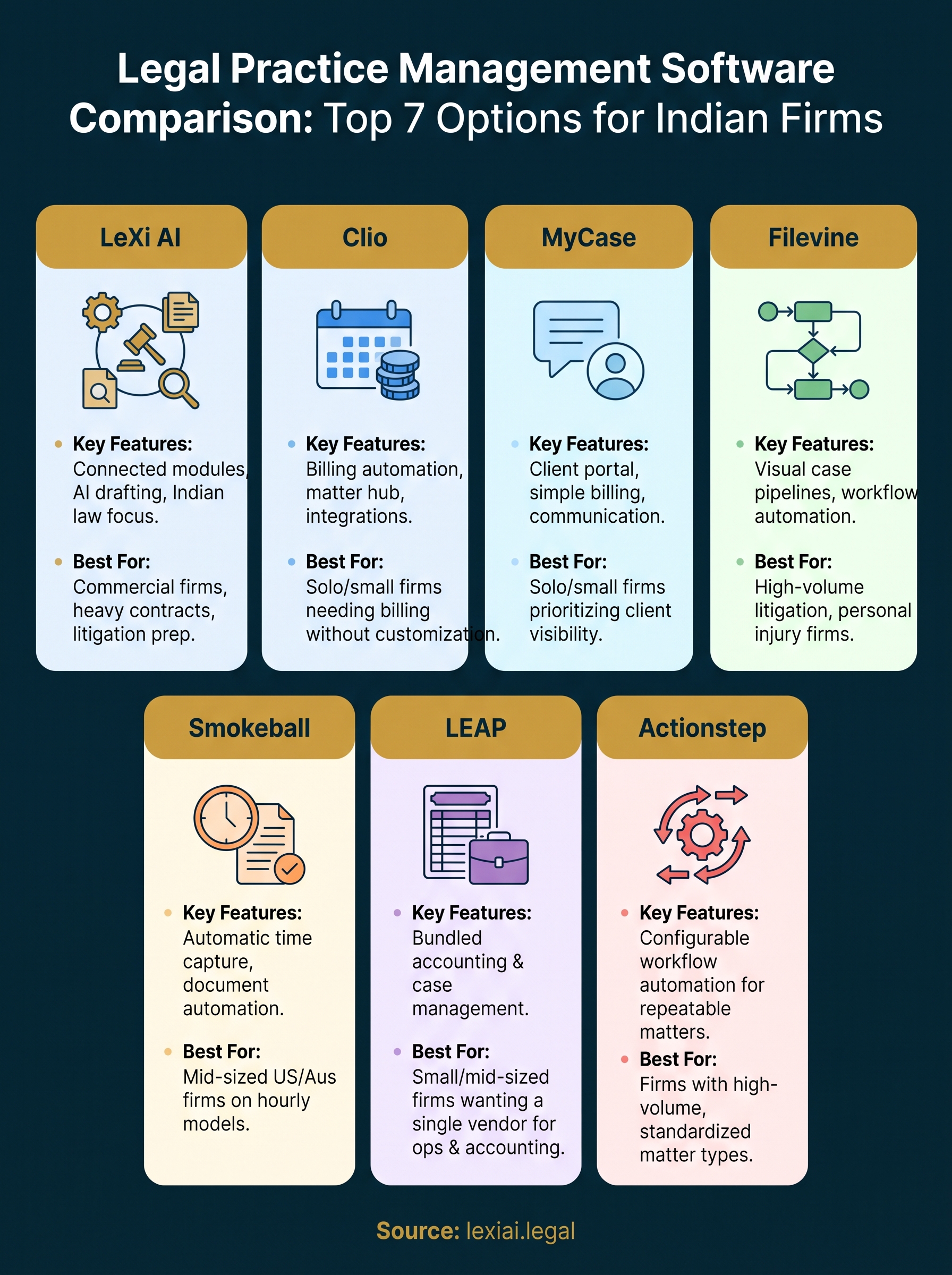
Seven tools, seven different strengths, and no single winner for every firm. If your practice runs mostly on US or UK billing conventions, Clio, MyCase, or Smokeball handle that comfortably. If you manage high-volume litigation pipelines, Filevine or Actionstep reward the setup effort. LEAP suits firms wanting accounting bundled in from day one. This legal practice management software comparison keeps coming back to the same fork: a billing-and-case tool alone, or a platform that also drafts and researches.
But if your firm drafts contracts, prepares for hearings, and researches Indian precedent as part of daily work, none of the US-built tools close that gap on their own. That is where connected platforms built for Indian law change the math, since you stop paying for separate drafting and research subscriptions on top of case tracking.
Compare what each module actually costs against what you currently spend across disconnected tools, then decide based on your caseload, not the marketing page. If you want to see where LeXi AI's pricing lands for your firm size, check the LeXi AI pricing page or start a free trial before you renew anything else.